Diastema Explained: How to Close a Gap Between Your Front Teeth
Author / Clinical lead: Dr. Fuat Biter, Founder Dentist, Stom Dental Centre Antalya
A gap between the front teeth — known clinically as a diastema — is one of the most searched and most misunderstood topics in dentistry. For some people it is purely cosmetic; for others it affects speech or biting comfort; and in children, it is very often a completely normal stage of development that needs no treatment at all. This guide explains the difference between a diastema and a generalized diastema, why the gap forms, when it closes on its own, and which treatment is chosen in which situation — based on published clinical evidence.

- Diastema usually refers to a gap between the two upper front teeth; a generalized diastema describes multiple gaps spread across several teeth.
- Extremely common in children: seen in roughly half of 6-8-year-olds, and the frequency drops sharply with age (around 5% in adults aged 18-50).
- Gaps under 2 mm at age 9 usually close on their own as the lateral incisors and canines erupt — early intervention is not always necessary.
- Composite bonding retained fully in 91% of cases at a 5-year clinical follow-up, with no restorations debonding completely.
- A prominent labial frenum (the tissue connecting the upper lip to the gum) is a well-documented cause and can sometimes require a frenectomy.
What Is a Diastema, and How Is It Different From a Generalized Diastema?
A diastema is a wider-than-normal space between two teeth, most commonly between the upper central incisors (midline diastema). A generalized diastema is a broader term describing multiple gaps distributed across several teeth at once — for example, spacing between both front and lateral teeth simultaneously.
In most cases a diastema is purely a cosmetic concern, but in some patients it can also affect speech (particularly sibilant sounds) or chewing function. In those cases, closing the gap becomes a functional need rather than a cosmetic choice.
Why Does a Diastema Form?
If tooth size is small relative to the jaw (microdontia) or teeth are missing, natural spacing can occur between the remaining teeth.
When the tissue connecting the upper lip to the gum extends between the roots of the front teeth, it can physically prevent the two incisors from drifting together.
Constant pressure from the tongue against the front teeth during swallowing can gradually push teeth forward and outward, creating a gap over time.
Congenitally missing lateral incisors, or small/peg-shaped lateral incisors, can leave space between neighbouring teeth.
Advanced periodontal disease weakens the tissue supporting the teeth, which can allow teeth to shift and create spacing.
Prolonged thumb-sucking or similar habits during development can affect the position of the front teeth.
Diastema in Children: When Should You Actually Worry?
A diastema is extremely common during childhood and, in most cases, is simply a temporary stage of development. The data tells a clear story:
| Age group | Prevalence of a diastema ≥2 mm |
|---|---|
| 6-8 years | Roughly 50% (very common during mixed dentition) |
| 8-11 years | 19% |
| 12-17 years | 6% |
| 18-50 years (adults) | 5% |
This steady decline has a physiological explanation: as the lateral incisors and canines erupt, the space that once separated the central incisors typically closes on its own. Studies show that a diastema narrower than 2 mm at age 9 resolves spontaneously in most cases. This is why, in children, monitoring the natural eruption process — with regular dental check-ups — is usually the right approach rather than early, aggressive treatment.
Diastema Closure Methods: A Comparison
| Method | How it works | Key feature |
|---|---|---|
| Composite bonding | Single visit, usually no tooth preparation needed | 91% full retention at 5-year follow-up, fully reversible |
| Porcelain veneers | Minimal tooth preparation may be required | Longer-lasting than bonding, also improves colour and shape |
| Orthodontics | Braces or clear aligners, weeks to months | Gold standard when multiple teeth or bite alignment are involved |
| Combination approach | Orthodontics partially closes the gap, bonding finishes the rest | Reported as one of the most predictable outcomes in the literature |
Which Method Is Right — and When?

- A single, narrow midline gap is usually treated with composite bonding first — it’s fast, tooth-conserving, and reversible.
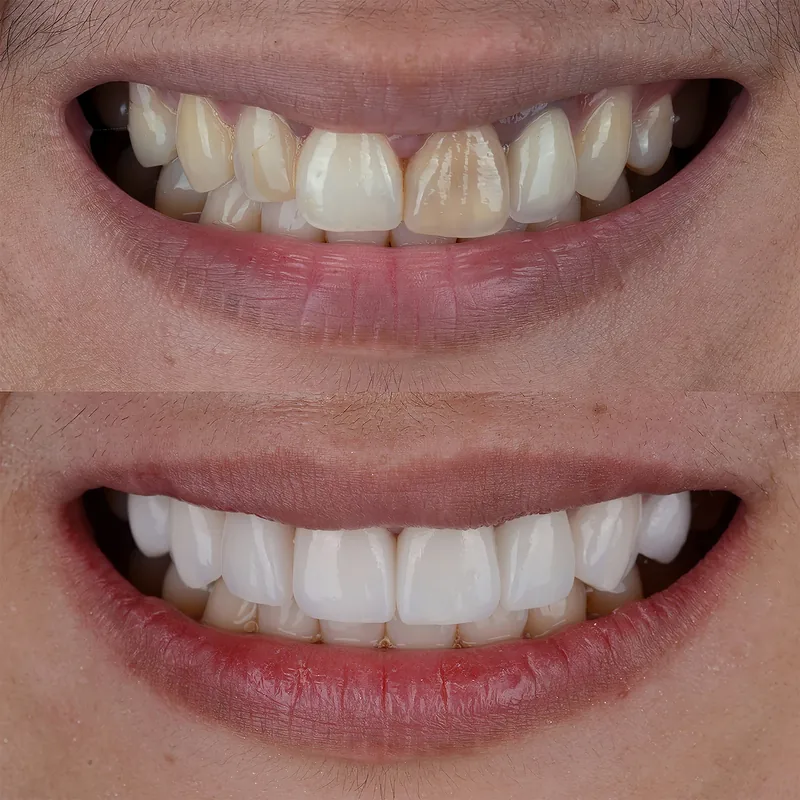
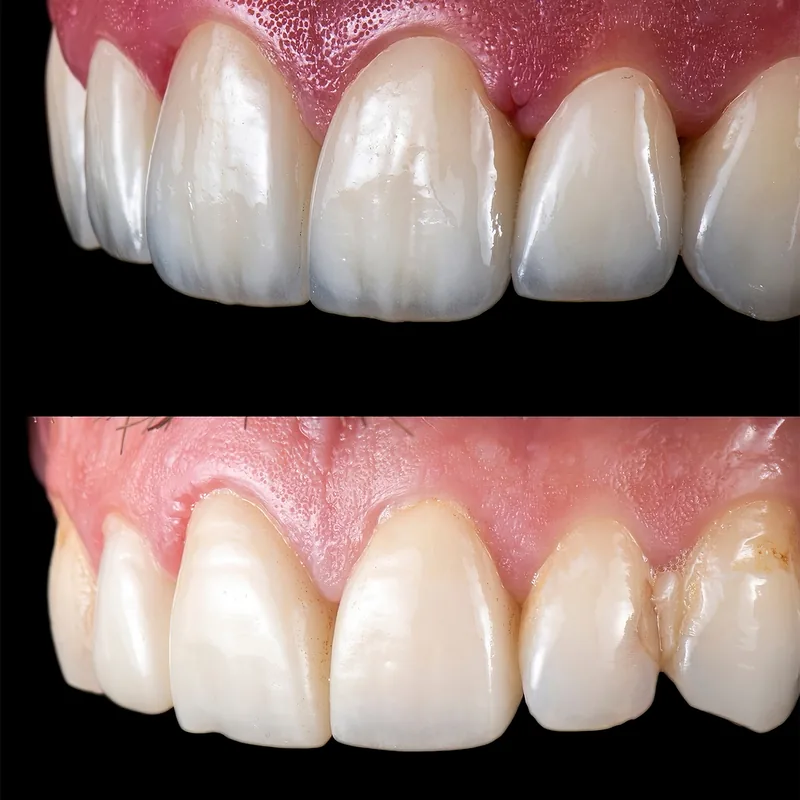
- If discoloration, wear, or shape irregularities accompany the gap, porcelain veneers offer a more comprehensive cosmetic solution.
- A generalized diastema (spacing across multiple teeth) or an accompanying bite problem should be evaluated for orthodontic treatment first — bonding or veneers only mask the underlying alignment issue, they don’t correct it.
- For larger gaps, orthodontics is frequently used to narrow the space first, with bonding completing the closure — a combination that tends to produce more balanced tooth proportions than bonding alone.

Is a Frenectomy Necessary?
In some diastema cases, the underlying cause is a labial frenum — the tissue connecting the upper lip to the gum — that extends between the roots of the front teeth. The literature describes a strong association between a high frenal attachment and a midline diastema. In these cases, bonding or veneers alone may not be enough, because the frenum tissue can continue to hold the teeth apart.
The option considered here is a frenectomy: a minor surgical procedure to correct the frenum attachment. A frenectomy is rarely a standalone treatment — it is typically planned alongside cosmetic closure (bonding, veneers, or orthodontics). Whether and when it’s needed depends on the type of frenum attachment and the size of the diastema, and should be assessed individually by your dentist.
“The first question I ask most of my diastema patients is: what bothers you about this gap — the look, or a difficulty with speech or biting? The answer often changes the recommended approach completely. Not every gap needs the same solution.”

Frequently Asked Questions
What is a generalized diastema?
A generalized diastema describes spacing that isn’t limited to one area but appears between several teeth at once. Unlike a single midline diastema, it is usually linked to tooth-jaw size mismatch, missing teeth, or skeletal factors, and often requires an orthodontic evaluation.
Planning dental treatment in Antalya?
Get a free, no-obligation assessment from our clinical team — we reply within 24 hours.
How is a diastema closed, and which methods are most commonly used?
The most common methods are composite bonding (single visit, no tooth removal), porcelain veneers (longer-lasting, added cosmetic improvement), and orthodontic treatment. A single narrow gap is usually treated with bonding; multiple gaps are usually treated with orthodontics; extensive cases often combine both.
Does a diastema close on its own?
Often yes, in children. Most gaps narrower than 2 mm at age 9 close on their own as the lateral incisors and canines erupt. In adults, after permanent dentition is established, spontaneous closure is not expected.
What causes a diastema?
The most common causes include a mismatch between tooth size and jaw size, a prominent upper labial frenum, a tongue-thrust habit, missing or small lateral incisors, and advanced gum disease. Several causes can be present at once.
How long does composite bonding for a diastema last?
In a 5-year clinical follow-up, 91% of composite diastema restorations retained full material without any loss, and none debonded completely. Over the long term, some colour touch-up or minor repair may eventually be needed.
Is orthodontics or bonding better for closing a diastema?
For a single narrow gap, bonding is fast and effective. When multiple teeth are affected or a bite issue is present, orthodontics is preferred. For large gaps, a combination — orthodontics first, then bonding — tends to give the most balanced result.
Does every diastema need a frenectomy?
No. A frenectomy is only considered when the gap is caused specifically by a prominent labial frenum. Diastemas caused by tooth size or missing teeth generally do not require surgery.
Can a diastema affect speech?
In some cases, yes — particularly with sibilant sounds (s, z), since airflow passes differently through the gap. In these cases, closing the diastema can also improve speech clarity.
Sources
- Direct Midline Diastema Closure with Composite Layering Technique — PMC: bonding technique and one-year clinical outcomes.
- Five-year clinical follow-up: composite diastema restorations retained fully in 91% of cases, no complete debonding — clinical observation data.
- Association of Maxillary Labial Frenum Attachment and Insertion With Midline Diastema in Children — PMC (2025): cross-sectional study on frenum-diastema association.
- Association between superior labial frenum and maxillary midline diastema — a systematic review — ScienceDirect: high frenal attachment as an etiological factor.
- Maxillary midline diastema prevalence data: ~50% at ages 6-8, 19% at 8-11, 6% at 12-17, 5% in adults 18-50 — epidemiological reviews.
- Spontaneous closure of diastemas under 2 mm at age 9 — paediatric dentistry literature (AAPD review, “The midline diastema: a review of its etiology and treatment”).
- Comprehensive Treatments for Congenitally Missing Teeth and Generalized Diastema — PMC: definition and treatment options for generalized spacing.
- Long-term survival of porcelain laminate veneers (95.5% at 10 years) — cross-referenced with the A3/A4 veneer-longevity source dossier (PMC7961608).
This article is for informational purposes only and does not replace a dental examination. Treatment decisions for diastema closure should be made individually with your dentist, based on the size and cause of the gap and the patient’s age. Figures are drawn from independent scientific publications and are not a guarantee of outcome at any specific clinic.