How Long Do Dental Implants and Veneers Last? An Evidence-Based Care Guide
Author / Clinical lead: Dr. Telman İskender, Prosthodontist, Stom Dental Centre Antalya
“How long will my implant last?” and “How long can I expect my veneers to hold up?” don’t have a single honest answer — because the outcome depends heavily on what you do after treatment. The same implant system or the same veneer material can last very different lengths of time in two different patients. This guide explains what long-term clinical studies actually say about implant and veneer/crown longevity, which risk factors shorten their lifespan, and the concrete steps that extend it — based on data, not guesswork.

- 10-year implant survival: current studies report a range of 90-95%; single-tooth implant crowns specifically show 89.5%.
- 20-year implant survival: a 2024 meta-analysis found 92% in prospective studies and 88% in retrospective studies — with proper care, implants can function well for 20-30 years or more.
- Smoking roughly doubles the risk of implant loss — the single strongest modifiable risk factor.
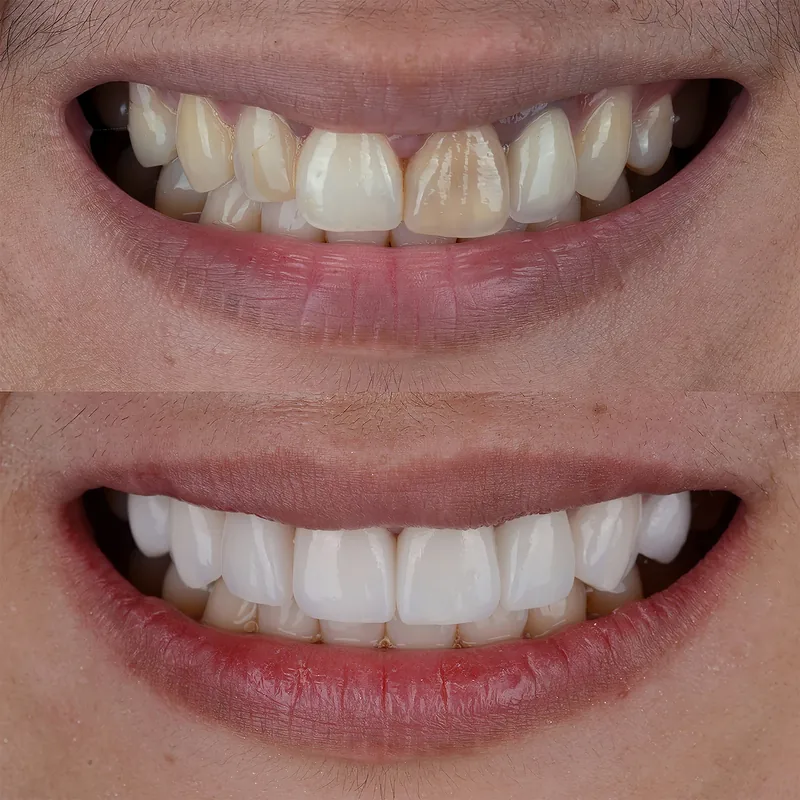
- Porcelain laminate veneers show 95.5% survival at 10 years (25 studies, 6,500 veneers); zirconia-based crowns range from 93.7% to 96.8% depending on the material.
- Veneers and crowns can temporarily affect speech — most patients adapt fully within a few days to two weeks.
Implant Longevity: What Do Long-Term Studies Say?
In the implant literature, “lifespan” is reported through two different measures: survival (is the implant still in place and functioning?) and the stricter measure of success (is there no bone loss or inflammation around the implant?). An honest guide should draw this distinction clearly — because as success criteria get stricter, the reported numbers naturally drop.
| Measure | Rate | Source type |
|---|---|---|
| 10-year implant function | 90-95% | Current systematic reviews |
| Single-tooth implant crown — 10 years | 89.5% | Survival study |
| 20 years — prospective studies | 92% (range 82-97%) | 2024 meta-analysis, Clinical Oral Investigations |
| 20 years — retrospective studies | 88% (range 78-94%) | Same 2024 meta-analysis |
| Mean 13.4-year follow-up | 94.6% | Long-term retrospective evaluation |
The spread between these figures may look surprising, but the reason is simple: different studies cover different patient groups (smokers vs non-smokers, cases needing bone grafts vs those not needing them) and different implant systems and follow-up protocols. The consistent takeaway is this: correct case selection, correct surgical planning, and — just as important — the patient’s long-term care all shape the outcome together.
What Actually Extends Implant Lifespan
Research shows implant loss is rarely “bad luck” — it’s usually linked to identifiable, and often preventable, factors. Here’s the evidence-based priority order:
Smoking roughly doubles implant loss risk (RR 2.07); it negatively affects bone density and wound healing. Quitting before and after surgery is the single most effective modifiable factor.
The area around an implant requires a different cleaning technique than a natural tooth (interdental brushes, super-floss). Correct brushing and interproximal cleaning from the moment the restoration is placed is the foundation of prevention.
High-risk patients (smokers, history of gum disease) are generally advised to attend supportive care every 3-4 months; lower-risk patients may be fine with an annual check. Catching a problem early keeps the fix small.
A history of periodontitis significantly raises peri-implantitis risk (OR 3.84). Keeping your natural teeth’s gum health in check also protects your implants — the two aren’t independent.
Excessive biting forces can fracture implant-supported crowns and overload the implant-bone connection. In patients with bruxism, a night guard protects both the implant and the opposing teeth.
Poorly controlled diabetes can impair healing and bone metabolism, reducing implant success. In well-controlled diabetes, this risk is significantly lower.
Gum bleeding, mild swelling, or sensitivity around an implant are early signs. Caught at the mucositis stage — before bone loss occurs — the condition is generally reversible.
With proper care, implants can function for 20-30 years or more — this isn’t a guarantee, but an evidence-based likelihood that depends heavily on the steps above.
Veneer and Crown Longevity: Real Numbers by Material

Before answering “what can I do to extend my veneers’ lifespan?”, it helps to know how long each material actually lasts. Systematic reviews show clear differences between materials:
| Restoration type | Survival rate | Follow-up / source |
|---|---|---|
| Porcelain laminate veneers (overall) | 95.5% | 10 years — 25 studies, 6,500 veneers |
| Feldspathic ceramic | 96.1% | 10.4 years average |
| Lithium disilicate (e.max type) | 96.8% | 10.4 years average |
| Leucite-reinforced ceramic | 93.7% | 10.4 years average |
| Composite laminate veneers | 88% (range 81-94%) | 2-8 years average follow-up |
Beyond material choice, another key factor is what the restoration is bonded to. When a veneer bonds entirely to enamel, bond strength is very high; when dentin is exposed (for example, in a tooth with a previous large filling), bond strength drops noticeably and debonding risk increases. This is why veneer planning should be personalised to the current condition of each tooth — a uniform thickness and preparation doesn’t fit every case.
What Actually Extends Veneer and Crown Lifespan
- Wear a night guard if you have bruxism. Teeth grinding/clenching is the leading cause of veneer fracture; a protective guard reduces this risk substantially.
- Don’t use your teeth as tools. Opening packages, nail-biting, biting hard objects (pens, ice) — these mechanical stresses cause most crown and veneer fractures.
- Keep up regular flossing and brushing. The veneer itself can’t decay, but the natural tooth structure at its margin can — neglected hygiene can lead to a new cavity that requires the veneer to be removed.
- Watch out for very hard or sticky foods. Especially with ceramic veneers, sudden impact forces (chewing ice, very hard-shelled foods) can cause cracking.
- Keep up with regular dental check-ups. A small change in marginal fit, caught early, is a simple fix; left unaddressed, it can require a larger repair.
What Happens When an Implant or Crown “Runs Out”?
This is what patients worry about most, yet discuss least. The truth is: an implant or crown “running out” isn’t a sudden, unexpected event — it’s usually a process that can be spotted well in advance.
For implants, the real risk isn’t the implant itself fracturing (extremely rare) — it’s the surrounding bone being lost to peri-implantitis. This process typically develops over years and can be caught early with regular X-ray monitoring. Caught at the early (mucositis) stage, treatment success is high; in advanced bone loss, implant removal — and, if the bone structure allows, a new implant — may be considered.
For crowns and veneers, “running out” usually shows up in one of three ways: decay forming under a leaking margin, a micro-crack or fracture in the ceramic, or debonding at the bonded surface. None of these are emergencies and none should cause panic — caught early at a routine check-up, the restoration is simply renewed, and the underlying tooth is usually preserved.
How Veneers and Crowns Affect Speech
After getting new veneers or crowns, some patients notice a temporary change in certain sounds — particularly “s” and “z”. The mechanism is mechanical: even a 0.5-1 mm change in front-tooth thickness or length briefly disrupts the airflow relationship between the tongue and teeth, and speech can be slightly affected until the tongue adapts to the new contact point.
This effect is temporary. Clinical observations show that most patients adapt fully within a few days — often faster in people who talk a lot, since their tongue gets constant “practice” — with some patients taking up to two weeks. Correctly planned, properly fitted veneers and crowns don’t cause a lasting effect on speech.
Planning dental treatment in Antalya?
Get a free, no-obligation assessment from our clinical team — we reply within 24 hours.
A practical tip to speed up adaptation: reading aloud, or repeating sentences rich in “s”/”z” sounds, can help the tongue adjust to the new tooth surface more quickly.

“I tell my patients the same thing every time: the quality of the implant and the restoration matters, but so does the regular follow-up afterward. The failures we see most often don’t come from the material or the surgery — they come from months of skipped check-ups.”

Frequently Asked Questions
How long do dental implants last?
Current studies report 10-year implant function in the range of 90-95%; single-tooth implant crowns specifically show 89.5%. With proper care, implants can function for 20-30 years or more, though the exact duration depends on smoking status, oral hygiene, and regular check-ups.
What can I do to extend the life of my implant?
The most effective steps, in order: quit smoking (roughly halves the risk), keep up daily interdental cleaning, attend regular check-ups every 3-12 months, use a night guard if you have bruxism, and keep chronic conditions like diabetes under control.
What can I do to extend the life of my veneers?
Use a night guard if you have bruxism, avoid using your teeth as tools (opening packages, chewing ice), keep up regular brushing and flossing along the margin, avoid very hard foods, and continue regular dental check-ups.
What happens when an implant “runs out”?
The implant itself rarely fractures; the real risk is the surrounding bone being lost to peri-implantitis. This progresses slowly and can be caught early with regular X-ray monitoring. Caught early, treatment success is high; in advanced cases, implant replacement may be considered.
How long do zirconia crowns last?
Depending on the specific material, ceramic crowns (including lithium disilicate, feldspathic, and zirconia-based systems) show 10-year-plus survival rates between 93.7% and 96.8% — among the best-performing materials in porcelain restorations.
Do veneers permanently affect speech?
No. New veneers can cause a temporary change, particularly with “s” and “z” sounds, but this typically resolves within a few days to two weeks. Correctly planned veneers don’t cause lasting speech problems.
How does smoking affect implant lifespan?
Smoking impairs bone density and wound healing, roughly doubling implant loss risk. Quitting or reducing smoking before and after surgery is the single most effective modifiable factor for implant longevity.
Does a night guard really extend implant and veneer life?
Yes, especially for patients diagnosed with bruxism. Excessive biting force is a leading cause of fracture in both implant-supported crowns and natural-tooth veneers; a night guard distributes that force and reduces the risk.
Sources
- How far can we go? A 20-year meta-analysis of dental implant survival rates — Clinical Oral Investigations (2024): 92% prospective (82-97%), 88% retrospective (78-94%) survival.
- Long-term (10-year) dental implant survival: a systematic review and sensitivity meta-analysis — Journal of Dentistry / PubMed (2019): 90-95% 10-year implant function, 89.5% single-tooth implant crown survival.
- Long-term retrospective implant evaluation: 94.6% survival at a mean 13.4-year follow-up.
- Smoking and Dental Implants: A Systematic Review and Meta-Analysis — PMC: smoking approximately doubles implant loss risk.
- Tobacco Smoking and Smoke-Free Products as Risk Factors for Dental Implants: A Systematic Review — Clinical Oral Implants Research (2026).
- Smoking RR 2.07 (CI 1.41-3.04); history of periodontitis OR 3.84 (CI 2.58-5.72) — umbrella review of peri-implant disease risk factors (2024).
- Supportive care/recall interval of 3-4 months for high-risk patients: Stiesch et al. (2023); Monje/Nart (2024); AO/AAP Consensus Report (2025).
- Long-Term Survival and Complication Rates of Porcelain Laminate Veneers in Clinical Studies: A Systematic Review — PMC (2021): 25 studies, 6,500 veneers, 95.5% 10-year survival.
- Clinical survival and complication rate of ceramic veneers bonded to different substrates: A systematic review and meta-analysis — Journal of Prosthetic Dentistry (2024): feldspathic 96.1%, lithium disilicate 96.8%, leucite-reinforced 93.7% at 10.4 years average.
- Composite laminate veneer pooled survival of 88% (81-94%), 2-8 years average follow-up — Lim et al. (2023).
- Phonetic effects: 0.5-1 mm change in tooth thickness/length temporarily affecting the tongue-tooth relationship and sibilant (s/z) sound production, with most patients adapting within days to two weeks — clinical review literature.
This article is for informational purposes only and does not replace a dental examination. If you have symptoms, please see a dentist. Figures are drawn from independent scientific publications and are not a guarantee of outcome at any specific clinic.