Zygomatic Implants: Fixed Teeth When You Have Been Told There Is “Not Enough Bone” — The Complete 2026 Guide
Medically reviewed by Dr. Telman İskender, Oral Implantology & Full-Arch Reconstruction, Stom Dental Centre Antalya
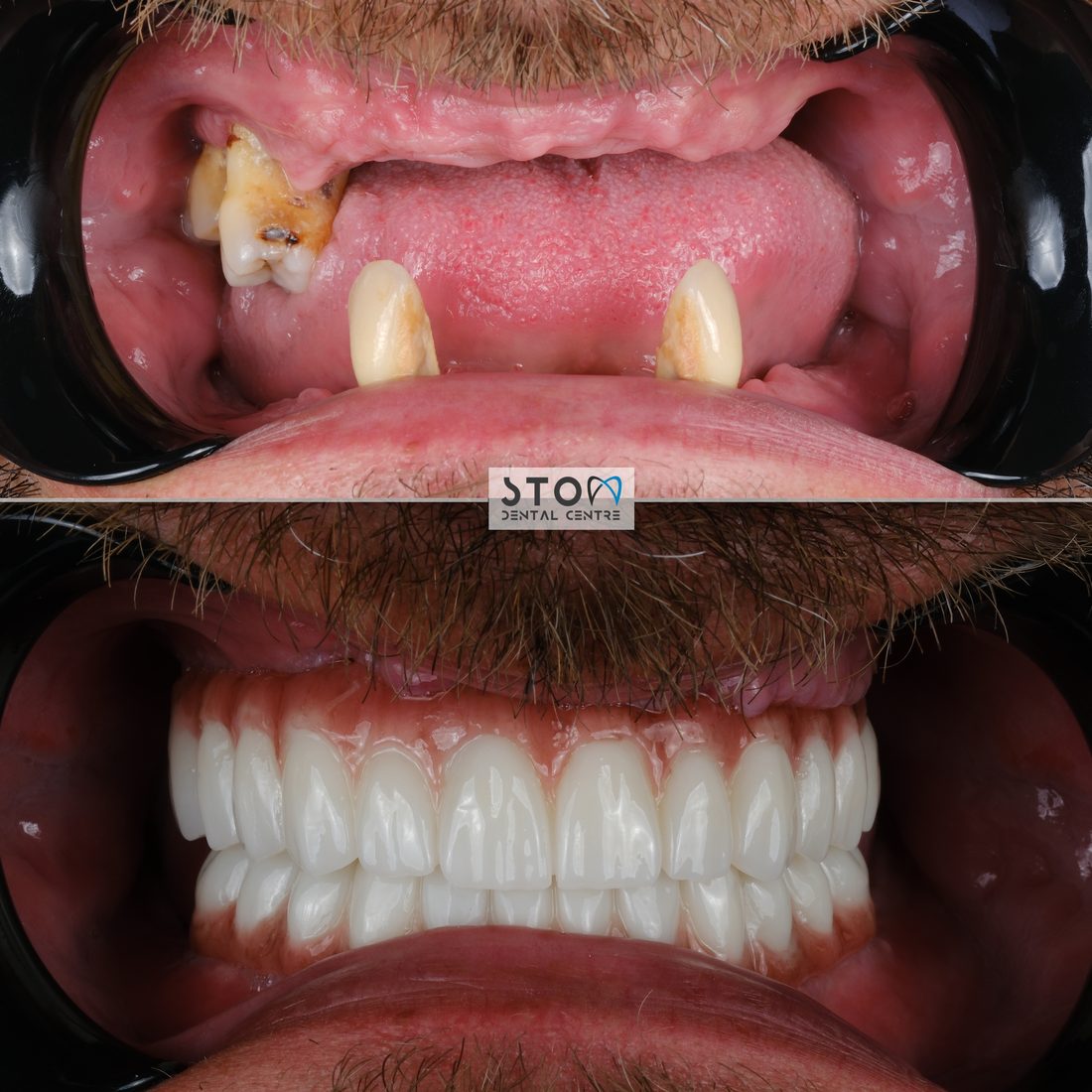
Almost every patient who ends up needing zygomatic implants has the same story: they lost their upper teeth or wore an upper denture for years, finally decided to get fixed implants — and were told by a clinic that they “don’t have enough bone.” Some are offered a year of bone grafting first. Many are simply turned away. What they are almost never told is that there is a well-documented, decades-old solution designed for exactly this situation: implants that skip the missing jawbone entirely and anchor in the zygoma — your cheekbone.
This guide is deliberately thorough. It explains the anatomy, how you are assessed, the different surgical protocols, what the surgery and recovery actually involve day by day, the honest risks, the success rates, who is not a candidate, and what it costs. By the end you will be able to judge a treatment plan — not just trust one.

- What they are: long implants (30–55 mm) anchored in the cheekbone instead of the upper jaw, for cases of severe upper-jaw bone loss.
- Who they are for: patients told they have “not enough bone”, failed sinus lifts/grafts, long-term upper-denture wearers, failed previous upper implants.
- The big advantage: usually fixed teeth without bone grafting, with a fixed temporary bridge in 24–72 hours — instead of a year of waiting.
- Success rate: documented at 95–98% over multi-year follow-up in experienced hands.
- It is advanced surgery: the surgeon’s case volume matters more here than almost anywhere in dentistry. Choose the surgeon, not the price.
- Cost in Turkey: a fraction of European/US prices for the same protocol; the exact figure is a personal written quote after a CT scan.
Have you been told you “can’t have implants”? Send us your panoramic X-ray or CT scan on WhatsApp — Dr. İskender will tell you honestly whether zygomatic implants are an option for your case, in English, German, Russian or Turkish. The assessment is free.
What Is a Zygomatic Implant?
A standard dental implant is a titanium screw, usually 8–13 mm long, placed in the jawbone. It only works if there is enough healthy bone to hold it. After years of missing upper teeth — especially under a denture — the upper jaw resorbs (shrinks), and the maxillary sinuses expand downward into the space the roots used to occupy. This is called a pneumatized sinus. Eventually there is so little bone left in the back of the upper jaw that a normal implant has nothing to grip.
A zygomatic implant solves this from a completely different direction. It is a much longer implant (30–55 mm) that passes from the gum, alongside or through the residual jaw, and anchors in the zygomatic bone — the cheekbone. The cheekbone is one of the densest, most stable bones in the entire face; it carries the forces of chewing and almost never resorbs, even in patients who have had no upper teeth for decades. That is why it can provide solid anchorage when the jaw itself can no longer.
The technique was developed by Professor Per-Ingvar Brånemark — the same researcher who pioneered modern titanium dental implants in the 1960s — and has more than two decades of documented clinical use and published survival data behind it. It is not experimental; it is simply specialised.
How Do You Know You Need One? The Assessment
You do not decide on zygomatic implants — a CT scan does. The deciding factor is how much usable bone remains in the upper jaw, especially at the back.
When a surgeon reviews your cone-beam CT (CBCT), they are measuring bone height and width in millimetres at each potential implant site. Broadly:
- Enough bone everywhere → standard implants or a conventional All-on-4 / All-on-6. No zygoma needed.
- Bone at the front, severe loss at the back (a very common pattern) → often two standard front implants combined with two zygomatic implants at the back.
- Severe loss throughout the upper jaw → the “quad zygoma” approach, where four zygomatic implants carry the whole upper bridge.
This is why an honest clinic will never quote you a final price or plan for zygomatic implants from a photo alone. The plan comes from the scan. If you already have a recent panoramic X-ray or CT, that is the single most useful thing you can send for a first opinion.
Who Are Zygomatic Implants For?
This is not a first-line treatment. It is the solution for the cases conventional implantology cannot solve:
You were told implants are impossible without major grafting, or refused treatment entirely.
Previous augmentation did not provide enough usable bone, or failed to integrate.
Years of a full upper denture have flattened the jaw ridge severely.
Earlier upper implants were lost, leaving the bone even more compromised.
Severe periodontitis destroyed the upper supporting bone before the teeth were removed.
Selected reconstruction cases where jaw bone has been lost — assessed individually.
For the lower jaw, zygomatic implants are not used — the lower jaw rarely loses enough bone to need them, and a lower All-on-4 is almost always sufficient. Zygomatic implants are specifically an upper-jaw solution.
Zygomatic Implants vs. Bone Grafting vs. All-on-4
If you have severe upper-jaw bone loss, three paths are usually discussed. They are not equal:
| Criterion | Zygomatic implants | Bone grafting + implants | Standard All-on-4 |
|---|---|---|---|
| Works with severe bone loss | Yes — designed for it | Sometimes, after augmentation | Only if some bone remains |
| Bone grafting needed | Usually none | Yes — the whole point | Usually none |
| Time to fixed teeth | Often 24–72 hours (immediate load) | 6–12 months of healing first | Often 24–72 hours |
| Number of trips | Usually 1–2 | 2–3 over many months | Usually 2 |
| Total treatment time | Weeks to a few months | 9–18 months | 3–6 months |
| Surgical complexity | High — specialist only | Moderate to high | Moderate |
The honest summary: if you have enough bone, you do not need zygomatic implants — a standard All-on-4 or All-on-6 is simpler and the right choice. Bone grafting can also be excellent when there is a moderate deficit and you are not in a hurry. Zygomatic implants earn their place in one specific situation: severe loss, where grafting would mean a year or more of waiting — or has already failed. Their unique advantage is removing that wait.
Surgical Protocols: It Is Not One Operation
“Zygomatic implants” covers several protocols. Which one suits you depends entirely on your CT:
Two zygomatic + two/four standard implants
The most common configuration. Where the front of the jaw still has bone, two standard implants are placed there, and two zygomatic implants anchor the back. The bridge is then supported front and back.
Quad zygoma (four zygomatic implants)
Used when there is so little jawbone that even front implants cannot be placed. Four zygomatic implants — two on each side — carry the entire upper bridge on the cheekbones alone. It sounds dramatic, but in the right hands it is a predictable, well-documented protocol.
ZAGA — the modern, anatomy-guided approach
Older techniques placed the implant on a fixed path regardless of the patient’s anatomy, which sometimes left it bulging into the cheek or passing through the sinus. The ZAGA concept (Zygoma Anatomy-Guided Approach) tailors the implant path to each individual’s bone and sinus shape — often keeping it closer to the bone surface. This reduces sinus complications and is the standard a modern surgeon should be working to.
Combined with pterygoid implants
In some cases an implant anchored in the pterygoid region (further back) is added to support the very back molars. This is advanced, case-specific planning — another reason the surgeon’s experience matters.

The Procedure, Step by Step
- 3D CT planning. The CBCT scan maps cheekbone, sinus and residual jaw in three dimensions. Each implant’s trajectory is planned on the scan before you ever enter the operating room — this planning is what separates a safe, predictable result from a risky one.
- Anaesthesia. Depending on the case and your preference, surgery is performed under IV sedation or general anaesthesia, so you feel nothing during the procedure.
- Implant placement. The surgeon places the planned combination of zygomatic and standard implants. A typical full-arch zygomatic case takes roughly 2–3 hours.
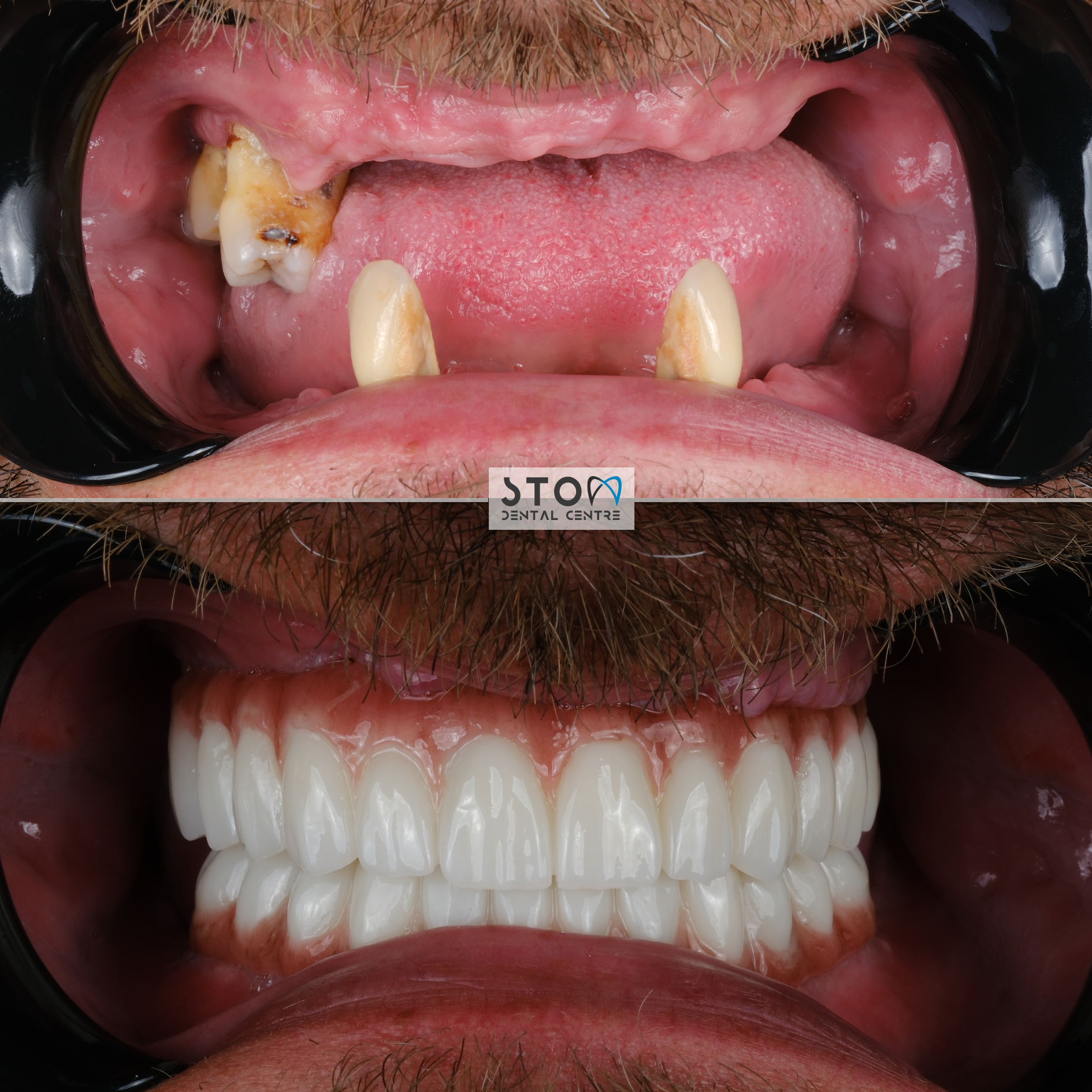
- Immediate fixed bridge. In most cases a fixed temporary bridge is attached within 24–72 hours, so you leave with fixed teeth — not a removable denture. (Occasionally a delayed protocol is chosen; your surgeon will explain why if so.)
- Integration. The implants fuse with the bone over the following months while you wear and function on the fixed temporary.
- Final bridge. On a second visit, the permanent bridge — typically titanium-reinforced zirconia or a high-grade hybrid — is fitted.
A Typical Patient Journey
The following is a representative case that illustrates the process; individual results vary.
Robert, 61, from the UK, had worn a full upper denture for eleven years. It had become loose, he avoided eating in public, and two clinics at home had told him he needed “extensive bone grafting” before implants could even be considered — a process quoted at over a year. He sent his old CT scan on WhatsApp for a first opinion. The scan showed the classic pattern: reasonable bone at the very front, almost none at the back under heavily pneumatized sinuses.
The plan: two standard front implants plus two zygomatic implants at the back, with a fixed temporary on day three. Trip one (5 days): consultation and CT on arrival, surgery under sedation on day two, fixed temporary bridge fitted on day four, review on day five before flying home with fixed teeth. Healing: four months at home, eating normally on the temporary. Trip two (4 days): the final titanium-reinforced zirconia bridge was fitted. Total chair time across both trips was less than most people imagine — and crucially, no grafting and no year of waiting.
Recovery, Week by Week
- Days 1–3: facial swelling and bruising are normal and peak around day 2–3, managed with prescribed anti-inflammatories and antibiotics. Soft, cool food. The fixed temporary is usually already in place.
- Week 1: swelling subsides. Most people are comfortable in normal daily life, on a soft diet. Careful hygiene around the bridge as instructed.
- Weeks 2–6: back to most normal foods gradually. Any stitches dissolve or are removed. Routine.
- Months 1–4: the implants integrate with the bone. You function normally on the fixed temporary throughout.
Most patients describe the recovery as more manageable than they feared and comparable to other oral surgery — the relief of having fixed teeth again, after years of a loose denture, is usually the headline.
The Honest Risks — and How They Are Minimised
No surgery is risk-free, and a clinic that pretends otherwise is not being straight with you. The risks specific to zygomatic implants, and how a good team reduces them:
| Possible risk | How it is minimised |
|---|---|
| Sinusitis (sinus irritation/infection) | ZAGA anatomy-guided placement that respects the sinus, strict asepsis, and screening for pre-existing sinus disease on the CT. |
| Implant not integrating | Careful case selection, correct loading, and a documented protocol; failures are uncommon and usually salvageable. |
| Soft-tissue or technical issues | Precise 3D planning and experienced surgical hands; corrected at review visits. |
| Orbital (eye-region) complications | Very rare; avoided by accurate planning and trajectory control — the core reason surgeon experience matters. |
The single most effective way to minimise every one of these is the same: an experienced surgeon, a proper CT-based plan, and honest case selection.
Success Rates and Long-Term Outcome
Published studies report long-term survival rates for zygomatic implants of roughly 95–98% over multi-year follow-up when performed by experienced surgeons — figures comparable to, and in many series matching, conventional implants. The decisive variables are case selection, surgical technique and ongoing hygiene. In practical terms, that means stable, fixed teeth that let people eat, speak and smile normally again, often after years of being unable to.
Who Is Not a Good Candidate?
Honesty cuts both ways. Zygomatic implants may be postponed or ruled out in cases of active, untreated sinus disease (treated first), uncontrolled diabetes or certain medical conditions, heavy smoking (which raises failure risk and should at least be reduced), or active untreated gum infection. None of these are automatic disqualifications — they are reasons for proper assessment first. And if your CT shows you actually have enough bone, a good surgeon will tell you that you don’t need zygomatic implants at all.
Why Patients Travel to Antalya for This
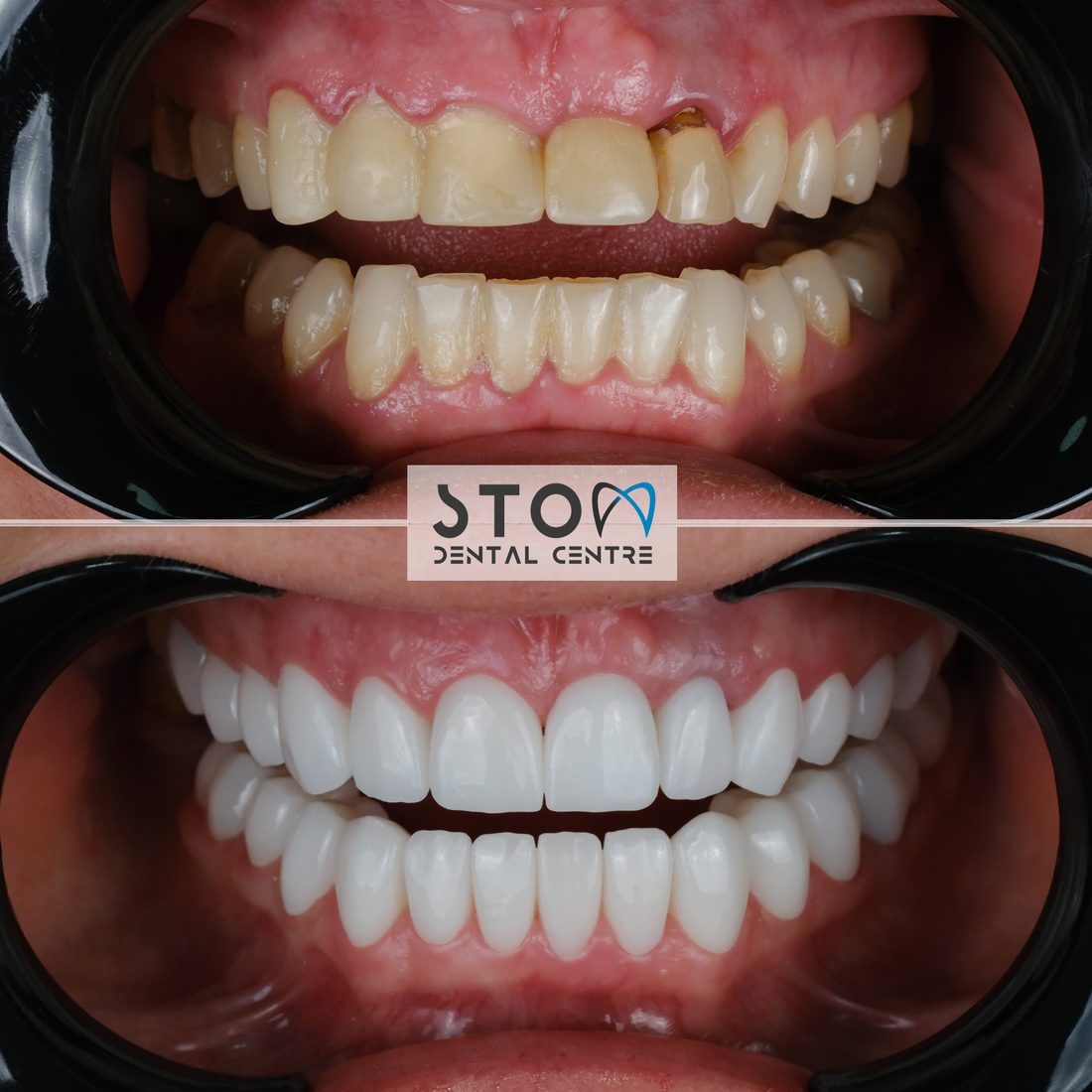
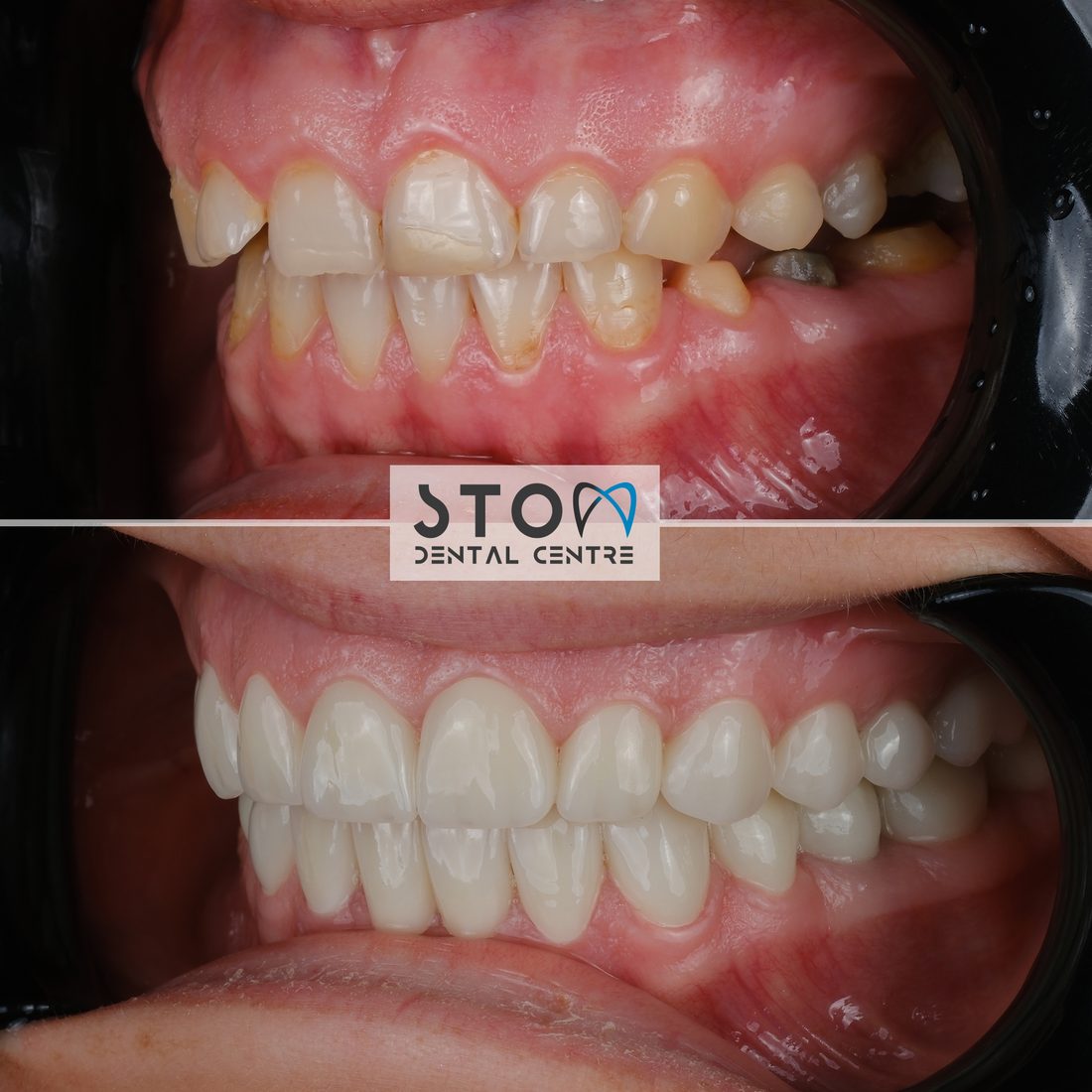
Zygomatic reconstruction is exactly the kind of case where the gap between a general dental clinic and a dedicated full-arch surgical team matters most. It is not a treatment you want done by a clinic that performs it occasionally. At Stom Dental Centre in Antalya, complex full-arch and zygomatic cases are part of routine practice — the same surgical focus behind our All-on-4 and full-arch implant work.
Combined with Antalya’s role as an established international treatment destination — direct flights from across Europe, mature medical-travel logistics, interpreters, and significantly lower treatment cost than Western Europe or the USA for the same protocol — it has become a realistic option for patients who were told at home that fixed teeth were impossible or unaffordable.
What Zygomatic Implants Cost
Full-arch zygomatic reconstruction in Turkey typically costs a fraction of European, UK or US prices for the same protocol — for many patients the saving is substantial even after flights and accommodation. But zygomatic cases vary enormously: the number of zygomatic vs. standard implants, whether one or both arches are treated, the final bridge material and any preparatory work all change the figure.
For that reason there is no honest “list price” for this treatment. After your CT scan is reviewed, you receive a fixed written quote for your specific case — so you know the full cost before you commit to anything.
Want to know if zygomatic implants could give you fixed teeth? The only way to know is from a CT scan. Send your existing scan or X-ray on WhatsApp and Dr. İskender will review it personally — free, with no obligation.
Frequently Asked Questions
What is a zygomatic implant?
A zygomatic implant is a longer-than-standard dental implant (30–55 mm) that anchors in the zygomatic bone — the cheekbone — instead of the upper jaw. It is used when the upper jaw has lost too much bone to hold normal implants.
Who needs zygomatic implants?
Patients with severe upper-jaw bone loss who have been told they have “not enough bone” for normal implants, those with failed bone grafts or sinus lifts, long-term upper-denture wearers, and people who have lost previous upper implants.
Can I avoid bone grafting with zygomatic implants?
Yes — that is their main advantage. Because they anchor in the dense cheekbone, zygomatic implants usually make fixed teeth possible without the months of bone grafting that conventional implants would require in a severely resorbed jaw.
Do I get fixed teeth immediately?
In most cases a fixed temporary bridge is fitted within 24–72 hours of surgery, so you leave with fixed teeth rather than a removable denture. The permanent bridge is fitted on a later visit once healing is complete.
Is zygomatic implant surgery painful?
The surgery itself is done under IV sedation or general anaesthesia, so you feel nothing during it. Afterwards expect swelling and bruising for a few days, controlled with prescribed medication; most patients describe it as comparable to other oral surgery and more manageable than they expected.
How long does the surgery take?
A typical full-arch zygomatic case takes around 2–3 hours, depending on how many implants are placed and whether standard implants are combined with the zygomatic ones.
Are zygomatic implants safe? What is the success rate?
When performed by an experienced surgeon with proper 3D planning, zygomatic implants have high documented long-term success rates (broadly 95–98% in multi-year studies). Because the surgery is close to the sinus and eye region, surgeon experience is the single most important safety factor — this is not a procedure for an occasional-implant clinic.
Can I have them if I have sinus problems or am a smoker?
Active sinus disease is usually treated first, and heavy smoking raises failure risk and should be reduced. Neither is an automatic disqualification — both are reasons for proper assessment on a CT scan before planning.
What is “quad zygoma”?
“Quad zygoma” means four zygomatic implants (two on each side) support a full upper bridge. It is chosen when there is so little jawbone that standard front implants cannot be placed — the entire upper arch is then carried by the cheekbones.
How much do zygomatic implants cost in Turkey?
In Turkey, full-arch zygomatic reconstruction typically costs a fraction of European, UK or US prices for the same protocol. Because every case differs in the number and type of implants, the exact figure is given as a fixed written quote after your CT scan is reviewed.
Related guides
- All-on-4 dental implants in Antalya — fixed teeth in 72 hours
- Dental implants in Turkey — the complete 2026 guide
- Turkey teeth gone wrong — the 2026 safety guide
Ready for an honest answer? Stom Dental Centre, Muratpaşa/Antalya — led by Dr. Telman İskender, treating international patients in English, German, Russian and Turkish. Free CT review, written quote within 24 hours, full surgical aftercare protocol.