Composite vs Porcelain Veneers: The 2026 Decision Guide — Which One Is Right for Whom?
“Composite or porcelain?” — it is one of the first questions almost every patient considering a smile makeover asks, and one of the most poorly answered questions on the internet. One camp markets composite veneers as “an economical miracle that delivers the same result as porcelain”; the other declares “composite is rubbish, porcelain only.” Neither is true. The reality is this: composite veneers and porcelain veneers are two different tools designed for different patient profiles — and the right question is not “which is better?” but “which is right for me?” This guide does not introduce the materials; we have already covered that in detail in our veneer types comparison guide. Here we focus exclusively on the decision process: which option do your budget, time horizon, tooth structure, habits and expectations point to — backed by scientific data, with no marketing gloss.

- Porcelain veneers are the long-term champion: a systematic review reports a 10-year cumulative survival of 95.5% (25 studies, 6,500 veneers).
- Composite veneers have a shorter lifespan: a meta-analysis shows overall survival of 88% at a mean follow-up of 2–8 years (91% for the direct technique).
- The staining difference is pronounced: in a clinical comparison, a share of direct composite veneers showed discoloration at 12 months, while porcelain veneers showed none at all.
- Composite’s advantage is repairability: discoloration can usually be corrected by polishing, and fractures can be repaired chairside in the same visit.
- The cost balance: composite veneers are markedly more economical; but because they need more frequent renewal and maintenance, a 10+ year total-cost calculation narrows the gap.
What Is the Decision Based On? Two Materials, Two Different Philosophies
The short answer: composite veneers are the product of a “fast, economical and reversible” philosophy, porcelain veneers of a “long-lasting, stable in form and color” philosophy. A composite veneer is a filling-based restoration that the dentist sculpts by hand directly in the mouth; it is usually completed in a single visit, and little or no tooth substance is removed. A porcelain veneer, by contrast, is a thin ceramic shell fabricated in a laboratory and bonded to the tooth; it requires several visits and precise preparation.
In this guide we will not repeat the technical details of the two materials — you can find the structural differences between porcelain, E-Max and composite in the 2026 veneer types guide, and the step-by-step composite procedure and its cost logic in the composite bonding guide. Here we are answering just one question: which patient should walk through which door?
7 Decision Criteria: Composite Veneers vs Porcelain Veneers
1. Budget: today’s price or total cost?
The direct answer: composite veneers are markedly more economical — in the Turkish market, the per-tooth cost is generally a fraction of that of porcelain veneers. But an honest calculation does not end with the one-time price. Composite veneers need more frequent polishing, touch-ups and, eventually, replacement; porcelain veneers, with survival rates extending beyond 10 years, last most patients a long time on a single investment. If your short-term budget constraint is real, composite is a sensible starting point; over a 10+ year total-cost horizon, the gap is smaller than it first appears.
2. Time horizon: how many years will you wear this smile?
The data paint a clear picture: for porcelain veneers, a systematic review reports a 10-year cumulative survival of 95.5%; a recent material-specific meta-analysis found 96.8% for lithium disilicate and 96.1% for feldspathic porcelain at 10.4 years. For composite veneers, a meta-analysis shows overall survival of 88% at 2–8 years of follow-up (91% with the direct technique). Translated into practice: for a patient aiming at “a beautiful smile for the next 3–5 years,” composite is defensible; for a patient who wants to “do this once and forget it for many years,” porcelain is clearly ahead.
3. Staining tendency: coffee, tea, smoking
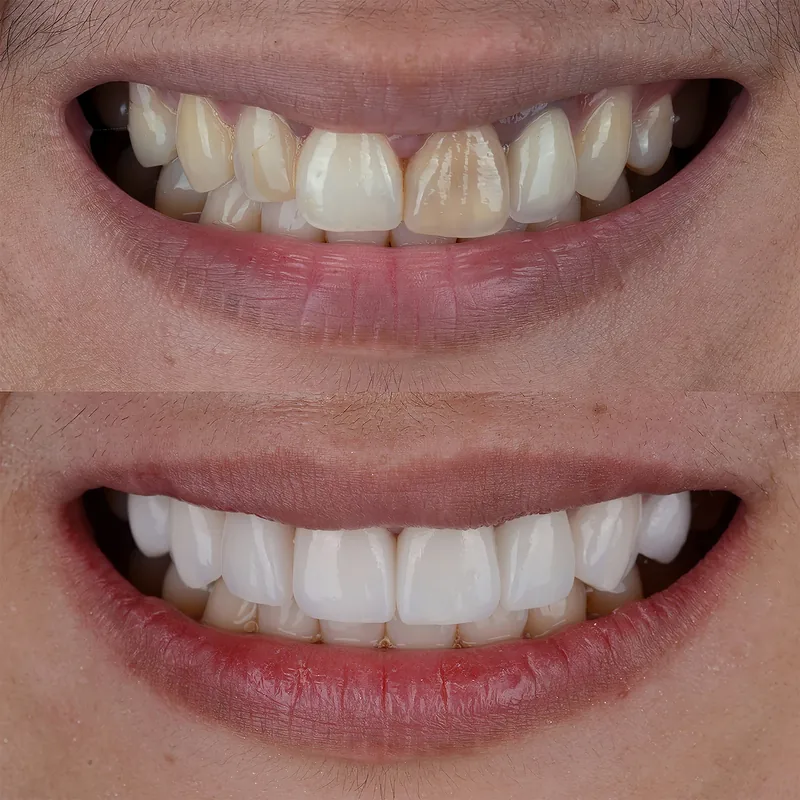
This is where the difference affects patient satisfaction the most. Composite, because of its organic resin matrix, is prone to absorbing pigments; in a clinical comparison, a share of direct composite veneers showed mild-to-moderate discoloration within the first 12 months, while porcelain veneers showed no discoloration at all. Porcelain’s glazed surface is like glass; it does not hold coffee or cigarette stains. If you drink several cups of coffee/tea a day or smoke, do not hide it from your dentist: this habit profile is exactly where composite is weakest and porcelain is strongest. If composite is chosen anyway, regular professional polishing must be written into the plan from the start.
4. Tooth substance: the “will my teeth be ground down?” worry
This is composite veneers’ strongest card: in most cases, little or no tooth substance is removed, which makes the procedure largely reversible. Porcelain veneer preparation, however thin, does involve permanent reduction — but even here the picture has changed: because modern ceramics can be fabricated at 0.3–0.5 mm thickness, the reduction stays within the enamel layer in most cases, and an expert consensus stresses that keeping the preparation confined to enamel is the key to long-term success. Still, the principle stands: enamel that has been removed does not grow back. For the patient who says “I don’t want my teeth touched at all,” composite (or, in suitable cases, no-prep/ultra-thin porcelain) comes onto the table — a matter to discuss with your dentist case by case.
5. Bruxism: clenching and grinding
Clenching stresses both materials, but in different ways. Composite is more flexible, so small chips and wear are common — but they are easily repaired in the mouth. Porcelain is harder and holds its shape; but if it fractures, the veneer usually has to be replaced entirely; indeed, in long-term data, fracture is the number-one complication of porcelain veneers and occurs mostly in the early years. The honest summary: with uncontrolled bruxism, no veneer type is comfortable — first a night guard and occlusal adjustment, then the material decision. For a patient who will wear a night guard consistently, porcelain’s form stability becomes an advantage; for a patient who knows they will not, composite’s repairability is more forgiving.
6. The tooth’s starting condition: minor touch-up or comprehensive transformation?
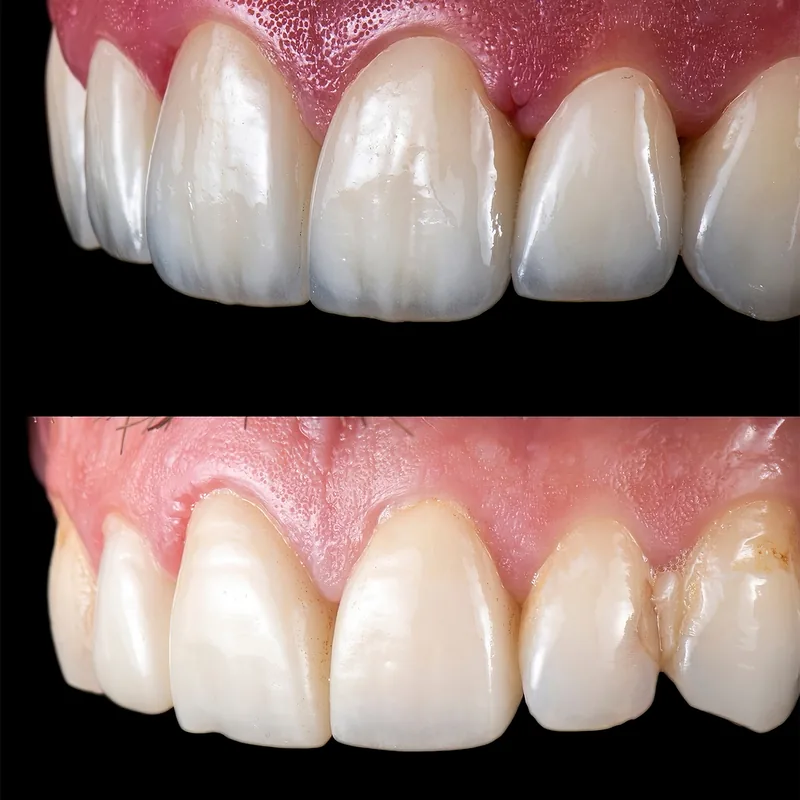
For a small chip on a single tooth, a tiny gap (diastema) or a slight shape irregularity, a comprehensive porcelain plan is usually unnecessary — a precisely targeted composite application protects both tooth substance and budget. Conversely, in advanced discoloration, widespread shape problems, old large fillings or a cohesive smile design spanning several teeth, porcelain’s color depth, translucency and precision of form exceed what composite can achieve by hand. A rough compass: the more local and small the problem, the more composite comes to the fore; the more widespread and structural, the more porcelain does.
7. Maintenance discipline and repair expectations
A composite veneer is a “living” restoration: it wants at least one polishing/check-up per year, and in return problems are solved while they are small and cheap — discoloration is polished away, an edge chip is rebuilt in the same visit. A porcelain veneer is closer to “set and forget”: it needs no special care beyond routine dental check-ups, but when a problem does occur, the solution is usually more extensive and more costly. Ask yourself honestly: are you a patient who shows up for regular check-up appointments? If the answer is “no,” then low-maintenance porcelain may be more realistic for you than maintenance-hungry composite.
Decision Table: Composite Veneers vs Porcelain Veneers Head to Head
| Decision criterion | Composite veneers | Porcelain veneers |
|---|---|---|
| Initial cost | Markedly more economical | Higher investment |
| Scientific survival data | ~88% (2–8 yr follow-up, 91% direct technique) | 95.5% (10 years); 93.7–96.8% by material |
| Stain resistance (coffee/smoking) | Weak — regular polishing essential | Very high — glazed surface does not stain |
| Tooth substance preservation | Maximum — no/minimal reduction in most cases | Thin but permanent preparation (0.3–0.5 mm with modern ceramics) |
| Repairability | Chairside, same visit | Fracture usually means complete replacement |
| Number of visits | Usually a single visit | At least two visits + laboratory phase |
| Aesthetic detail (translucency, form) | Good — depends on the dentist’s hand skill | Top-level and predictable |
| Maintenance needs | Annual polishing/touch-up should be planned | No special care beyond routine check-ups |
The honest reading of the table: there is no winner of the columns, only winners of the rows. Which rows weigh most in your own life is what decides your choice.
5 Patient Profiles and the Right Choice for Each
Five different patients asking the same question can get five different correct answers. Let’s walk through the profiles most commonly seen in clinics:
25 years old, a slight gap and edge irregularity on two front teeth. The right direction: composite veneers. The teeth are barely touched, it is done in one visit, it does not strain the budget — and the door to porcelain remains open for later.
4–5 cups of coffee a day, plus cigarettes. The right direction: porcelain veneers. In this profile, composite dulls and discolors within months and enters a constant polishing cycle; porcelain’s glazed surface is indifferent to these habits.
Longevity and predictability come first, budget second. The right direction: porcelain veneers. The 95%+ survival data at 10 years is exactly what this expectation is buying. For current options such as E-Max veneers, see our E-Max guide.
The profile that says “I won’t give up tooth substance before seeing the result.” The right direction: composite first. A reversible composite veneer works like a “live rehearsal” of the target smile; once the patient is sure of the result, a minimally prepared porcelain veneer can follow later.
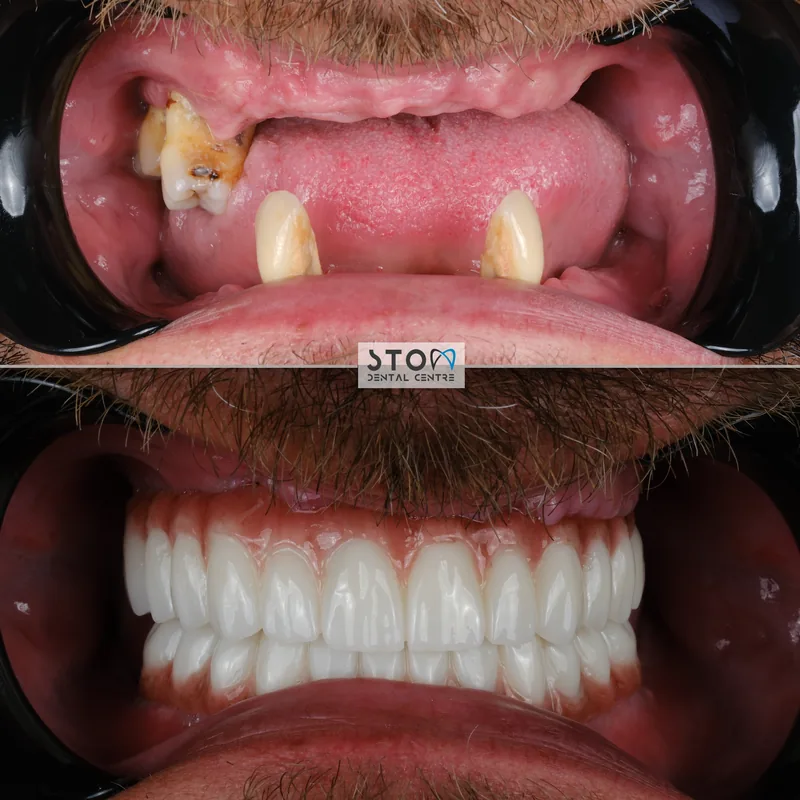
A change of color + shape + length spanning eight to ten teeth. The right direction: a porcelain-led plan. At this scale, composite runs up against the limits of handwork; the logic of cohesive design is explained in the Hollywood Smile guide.
These profiles are a compass, not a prescription: clinical findings such as enamel thickness, the bite relationship, gum levels and existing fillings can change the decision at the examination.
The Cost Reality: Is the Cheapest Option Always the Most Economical?
The direct answer: no — “the cheapest option” and “the most economical decision” are not the same thing. The initial cost of composite veneers in the Turkish market is well below that of porcelain; that is a fact, and for the right patient it is a major advantage. But the total cost of ownership has three components: initial fee + maintenance (polishing, touch-ups) + frequency of replacement. The 88% medium-term survival means that with composite, partial renewals must be built into the plan within a 5–10 year window; with porcelain, the 95%+ survival at 10 years keeps the likelihood of replacement low. The decision formula is simple: if your time horizon is short or you match profiles 1 and 4, composite’s low entry cost wins; if your horizon is 10+ years, porcelain’s annualized cost is unbeatable in most scenarios. Because concrete figures vary by clinic, number of teeth and case, we deliberately quote no prices here — for the current process and cost logic, the composite bonding guide is a good starting point.
Planning dental treatment in Antalya?
Get a free, no-obligation assessment from our clinical team — we reply within 24 hours.
Frequently Asked Questions
Are composite or porcelain veneers better?
Neither is “better” in absolute terms; each is right for a different profile. Composite veneers are economical, single-visit and reversible, but prone to staining and shorter-lived (~88% survival in the meta-analysis). Porcelain veneers demand a higher investment and a permanent preparation, but offer 95.5% survival at 10 years and a stain-proof surface. The decision is made based on budget, time horizon, habits and tooth condition.
How long do composite veneers last?
In meta-analysis data, the overall survival of composite veneers is 88% at a mean follow-up of 2–8 years; 91% has been reported for the direct technique. In practice, with good care (annual polishing, controlled habits), 5–10 years of function can be expected; but this span depends strongly on maintenance discipline.
How long do porcelain veneers last?
In a systematic review, the 10-year cumulative survival of porcelain veneers is 95.5%; for lithium disilicate, 96.8% at 10.4 years has been reported. In other words, after 10 years the great majority of veneers are still functioning without problems; the most common complication is fracture, generally in the early years.
Do composite veneers stain?
Yes, markedly more than porcelain. In a clinical comparison, a share of direct composite veneers showed discoloration within the first 12 months, while porcelain veneers showed none at all. The good news: superficial discoloration in composite can usually be brought back to a clinically acceptable level with professional polishing.
Do teeth need to be shaved down for composite veneers?
In most cases, no — composite veneers are applied either without touching the tooth at all or with minimal surface roughening, which is why they are considered largely reversible. Porcelain veneers, by contrast, require a thin (with modern materials, mostly 0.3–0.5 mm, ideally kept within the enamel) but permanent preparation.
Can composite veneers be converted to porcelain later?
Yes, and it is a common and sensible path. Because composite is applied to the tooth in a largely reversible way, it can be removed later and porcelain veneers planned when the patient wants longevity and color stability. Some patients deliberately use composite as a “rehearsal before porcelain.”
Which should I choose if I clench or grind my teeth (bruxism)?
The habit must be managed first: a night guard and an occlusal assessment come before the material choice. If the guard will be worn consistently, porcelain’s form stability is an advantage; if not, composite’s easy chairside repair is more forgiving. With uncontrolled bruxism, both materials are at high risk.
I drink coffee and smoke — are composite veneers right for me?
This is the scenario where composite struggles most: the resin structure absorbs pigments, and discoloration can become visible within months. If the habits will not change, porcelain veneers deliver a markedly more predictable result; if composite is chosen, regular professional polishing must be written into the plan from the start.
Sources
- Survival and Complication Rates of Resin Composite Laminate Veneers: A Systematic Review and Meta-Analysis — Journal of Evidence-Based Dental Practice (2023): overall survival of composite veneers 88% (CI 81–94%; mean follow-up 24–97 months); direct technique 91%, indirect 84%. sciencedirect.com
- Long-Term Survival and Complication Rates of Porcelain Laminate Veneers in Clinical Studies: A Systematic Review — Journal of Clinical Medicine (2021): 25 studies, 6,500 veneers; 10-year cumulative survival 95.5%; fracture the most frequent complication, mostly in the early years. pmc.ncbi.nlm.nih.gov
- Clinical survival and complication rate of ceramic veneers bonded to different substrates: A systematic review and meta-analysis — Journal of Prosthetic Dentistry (2024): survival at 10.4 years — feldspathic 96.1%; lithium disilicate 96.8%; leucite/glass-ceramic 93.7%. thejpd.org
- Clinical assessment of direct composite veneer and indirect veneers using a minimally invasive preparation technique — PMC (2025): cases of mild-to-moderate discoloration in direct composite veneers at 12 months; no discoloration in ceramic veneers; correctability of composite discoloration by polishing. pmc.ncbi.nlm.nih.gov
- 10-year practice-based evaluation of ceramic and direct composite veneers — Dental Materials (2022): 1,459 veneers (1,043 direct composite, 416 ceramic); ceramic significantly better in color match, surface roughness, partial fracture and wear; higher annual failure rates for composite. sciencedirect.com
- Minimal invasive microscopic tooth preparation in esthetic restoration: a specialist consensus — International Journal of Oral Science (2019): 0.3–0.5 mm veneer thickness with modern ceramics; the importance of keeping the preparation within enamel for bonding and long-term success. nature.com
This article is for information purposes and does not replace an examination. The veneer decision depends on findings that can only be assessed in a clinical examination, such as enamel thickness, the bite relationship and gum health. The figures are taken from independent scientific publications and are not a guarantee of results at any particular clinic.