Gummy Smile Treatment: Gum Contouring, Lip Repositioning and Other Options
Meet the Stom Dental Centre team
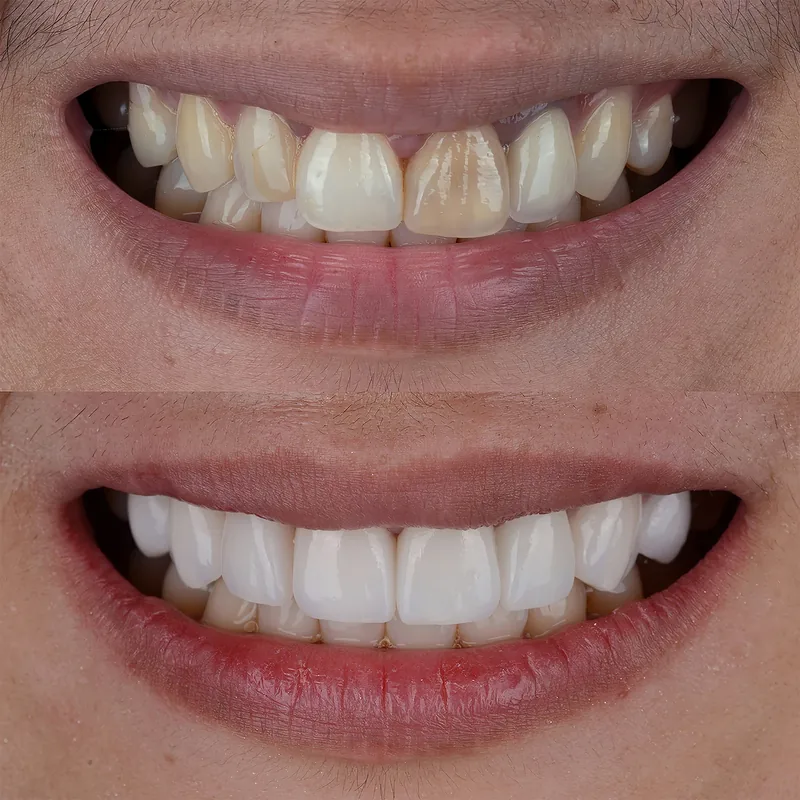
A gummy smile has no official definition. The papers we read use more than 2 mm of visible gum as the cut-off, or more than 3 mm, or more than 4 mm, and the people looking disagree. In an experiment with altered photographs, orthodontists noticed the gum from 2 mm, while general dentists and lay people called 4 mm noticeably unattractive. How you smile matters too: in 150 dental students at a Turkish university, a posed photo showed 0.35 mm of gum on average and a spontaneous video smile 1.44 mm.
So the first honest answer to “do I have a gummy smile?” is “it depends on who looks and how you smile”. This article covers what causes it, because the cause decides the treatment, what each option achieved in millimetres in studies, how long it lasted, what recovery involves, who may legally do what with botulinum toxin and why gum health comes first. The evidence has gaps, and we state them. It is general information; your dentist has to examine you.
- No single definition. Studies use 2, 3 or 4 mm of visible gum, and a posed photo understates a spontaneous smile.
- The cause decides the treatment. Gum contouring treats altered passive eruption; lip repositioning and botulinum toxin treat a hypermobile lip; over-erupted teeth can need braces and jaw excess needs jaw surgery. In one sample 55.3% of people had more than one cause.
- Surgical options kept more. In a meta-analysis (26 studies in the review, 21 pooled), the non-surgical group, which in the pooled data meant botulinum toxin, had 0.51 mm of effect left at 6 months and 0.04 mm at 12, while surgical options kept about 2.8 mm.
- Nothing is proven permanent. Gums can rebound within 3–6 months, reviews disagree on relapse after lip repositioning (about 25% at 12 months in one, near-stable at 36 months in another) and toxin wears off in roughly 12–36 weeks.
- Gum health comes first. Inflammation can mimic or enlarge a gummy smile, and the surgical trials enrolled periodontally healthy patients. No source we read shows veneers reducing gum display.
- Who may inject toxin is not settled. It is contested for dentists in Turkey and only partly addressed in Germany, and gummy smile is off-label in the US label we read.
What Actually Counts as a Gummy Smile?
There is no official threshold. Papers use more than 2 mm of gum above the upper front teeth at full smile (Maleki 2024), more than 3 mm (Lam and Chan 2022) or 4 mm or more (Al Jasser 2024). In the classic altered-photograph experiment, orthodontists noticed the gum from 2 mm, while general dentists and lay people rated 4 mm noticeably unattractive (Kokich 1999). In a 2026 video study in London up to 3 mm was acceptable for female smiles and 1.5 mm for male ones (Zhang 2026).
How the smile is recorded matters as much. In the Turkish student study a “very high smile line”, more than 2 mm, appeared in 8% of posed photos and 34% of spontaneous video smiles (Arifagaoglu 2022). That is why a dentist should look at your natural smile, not only at one photo. Digital smile analysis, as in our digital smile design explainer, is one way to record it.

How common is it? There is no reliable general figure. Studies give 6.9% in a community sample of 131 US adults (Tatakis 2024) and 34% of spontaneous smiles in Turkish dental students. The figure repeated everywhere, 10.5–29% of young adults, appears to merge two old samples that counted a “high smile line” rather than a gummy smile of a stated size: 10.57% of 454 American dental and dental hygiene students in 1984 (Tjan 1984) and 29% of 240 Koreans in a study cited by a 1999 review (Dong 1999), as tabulated by a 2011 systematic review (Passia 2011). We could not open the originals, so we do not use it as a prevalence.
Five Causes, and Why the Cause Decides the Treatment
Several things can show too much gum, and they need different treatments.
| Cause | What is happening | What addresses it |
|---|---|---|
| Altered passive eruption | The gum margin sits too far down the crown, so teeth look short | Gum contouring or crown lengthening |
| Hypermobile upper lip | The lip rises more than about 8 mm from rest to full smile | Lip repositioning or botulinum toxin |
| Vertical maxillary excess | The upper jaw is too long vertically | Jaw surgery; for mild cases contouring or lip repositioning may be considered |
| Worn or over-erupted front teeth | Teeth have moved down, often with a deep bite or wear | Orthodontic intrusion or periodontal surgery, usually with restorations |
| Gum overgrowth | Inflammation or medication such as cyclosporine, calcium-channel blockers or phenytoin thickens the gum | Treat inflammation or review the medication first; surgery if it persists |
Which cause dominates depends on who is counted. Among 53 people seeking treatment in the USA, a hypermobile lip alone explained 45.3% and altered passive eruption alone 20.8%, with 34% having both (Andijani 2019). Among 123 Saudi volunteers with 4 mm or more of display, altered passive eruption was present in 73.2%, a hypermobile lip in 51.2% and vertical excess in 45.5%, and 55.3% had more than one cause (Al Jasser 2024). A short upper lip, a textbook cause, was rare: none in the Saudi sample and 4.6% in the US community sample. Because causes combine, opinions depend on who examines you. Among 200 dentists who judged edited photographs, orthodontists attributed gummy smiles more often to the skeleton, periodontists and general dentists more often to the soft tissue (Turan 2026).
Before choosing an option the studies measured the gum at full smile, the length of the upper lip and how far it moves (the average in US adults was 5.9 mm), the proportions of the front teeth, and with a CBCT scan how far the gum margin and the bone crest lie from the enamel–cement junction. A side-view skull X-ray assessed the jaw. Gum inflammation was treated first. Our CBCT explainer shows what that scan is.
Gum Contouring and Crown Lengthening: For the Gum Margin
If the cause is altered passive eruption, the treatment is gum contouring, called aesthetic crown lengthening in the literature. Where the bone sits decides how far it goes: gum alone, or gum plus bone reshaping under a flap, aiming to re-establish about 3 mm of space for the gum attachment above the bone (Arroteia 2026). In a 22-patient series, display at full smile fell from 2.6 to 1.1 mm at six months and at least 73% were very satisfied (Silva 2015). In a two-year uncontrolled series of 22 healthy adults, crown length rose from 8.6 to 9.7 mm and held in the 18 patients reassessed (Arroteia 2026).

The gum can creep back. Reviews describe rebound, mostly in the first three months (Pilalas 2016), and in a restorative series only 0.5–1.2 mm of the surgically gained tooth was left at twelve months, with more regrowth in thick tissue (Pontoriero 2001). Contouring alone does not fix everything either. In a CBCT study of 42 Thai patients, 78.6% had altered passive eruption together with a hyperactive lip, and lowering the gum to the enamel–cement junction was predicted to bring display below 4 mm in only 66.7% (Janaphan 2026).
Which technique fits depends on the diagnosis, above all on how close the bone lies to the enamel–cement junction. Flapless and open-flap contouring were comparable in five trials of 180 patients, although flapless gave a smaller change in gum margin position (Oqlah 2025). A 3D-printed surgical guide in 16 patients shortened operating time but not healing, pain or stability (Borham 2024), and photobiomodulation did not speed healing or ease pain (da Silva Azevedo 2026). Reported downsides include dentin hypersensitivity (5–6% in a narrative review), rebound and, in thin gums, recession (Yaneva 2026). Our pages on periodontal soft-tissue surgery and surgical soft-tissue procedures describe the operation.
Lip Repositioning: For the Lip
If the lip rises too far, lip repositioning removes a strip of mucosa in the upper vestibule and sutures the edges, which limits how high the lip can lift. First described in 1973, it now has variants with muscle cutting or periosteal sutures. Reviews put the reduction in display at roughly 2–3.5 mm: 3.4 mm in a meta-analysis of four studies (Tawfik 2018); 2.87 mm at three months falling to 2.10 mm at twelve in another (Dos Santos-Pereira 2021); 3.06 mm at six months, 2.91 at twelve and 2.76 at 36 months in a third (Mendoza-Geng 2022). They disagree about relapse, about 25% lost by twelve months in one and nearly stable in the other, and a further review concluded that stability cannot be judged because definitions and long-term data are missing (Younespour 2021). Most of the evidence is case reports and small series.
Recovery is not trivial. Sutures stay 10–14 days, tension, swelling and mild pain are usual in the first weeks, and complications reported in individual studies include numbness, scarring, flap breakdown and, rarely, complete relapse (Ardakani 2021). Of 13 patients in one series, 69% said the discomfort or inability to move the lip early on was the worst part (Silva 2013). Severe vertical maxillary excess (more than 8 mm) and a minimal band of attached gum are named contraindications. In a 20-patient trial a CO2 laser gave a reduction not significantly different from a scalpel (1.96 against 1.44 mm) with less pain on day one (0.70 against 1.40 on a 0–10 scale) (Alkari 2025), and in an 18-patient trial toxin injected 15 days before lip repositioning gave a larger reduction at six months (5.2 against 3.2 mm in the trial’s abstract) (Antunes 2022).
Botulinum Toxin: Quick, Temporary and Legally Complicated
Botulinum toxin relaxes the muscles that lift the lip. A systematic review of 15 studies, 11 of them pooled, found a reduction of 3.22 mm at two weeks (nine studies) and 2.70 mm at three months (five studies), with large differences between studies and mostly moderate risk of bias (Rojo-Sanchis 2023). Another found 3.42 mm at two weeks, shrinking from week two and back close to baseline by 24 weeks (Zengiski 2022). A systematic review gave 12–36 weeks for the effect to persist (Rasteau 2022), and in a 30-patient study display was predicted to return to its 5.2 mm baseline at 30–32 weeks (Polo 2008). “Four to six months” appears in narrative reviews, but the measured studies range from roughly three to eight. Reviews call adverse events mild and transient; one narrative review adds bruising, an asymmetric smile with inappropriate technique and a drooping upper lip with overdose, and calls complications uncommon and most likely temporary (Fatani 2023). Doses are brand-specific and units cannot be converted between products (BOTOX Cosmetic label, 2024).
Two further points. Gummy smile is not a listed indication in the US BOTOX Cosmetic label we read, so it is off-label there; we did not check the EU or Turkish product information. And who may inject it is not settled. In Turkey, Ministry of Health letters, written in answer to a question about dentists, speak of physicians and certified physicians, the 2025 regulation on private outpatient facilities lets “physicians” provide aesthetic services, the regulation on dental facilities does not mention aesthetic or toxin services but allows no medical intervention there other than “oral and dental health services” (Art. 19(3)), and the Turkish Dental Association holds that dentists may use toxin for indications within their field and lists visible gum among reported uses, while its 2018 ethics report calls purely aesthetic injections with no link to an oral problem outside a dentist’s authority and notes that the Ministry takes a different view. We found no court decision on whether dentists may inject toxin; a 2016 Council of State decision on the Ministry’s botulinum letter, as reported in a later Ministry letter, concerned the acquired rights of certified physicians. We did not search the Council of State database directly. In Germany, the dental chamber says toxin use is in principle possible for dentists, but wrinkle injections treating the facial surface are in principle no longer part of dentistry, and none of the sources decides gummy smile specifically. We could not verify Russia. In any country, ask who injects, which product and dose, and on what legal and training basis.
Botulinum toxin is also studied for teeth grinding; see our article on bruxism and dental work.
Braces, Mini-Screws and Jaw Surgery
When the cause is the teeth or the jaw, the options change. Orthodontic intrusion with mini-screws pushes over-erupted front teeth up. A systematic review found only four prospective studies, all in deep-bite patients and all at high risk of bias (Alshammery 2021). A small randomised trial of 17 deep-bite patients found that mini-screws intruded the incisors by 2.48 mm against 1.14 mm with a Burstone arch, and gum display fell by 2.35 against 0.95 mm, with similar root resorption and no vertical relapse with mini-screws in three months of retention (Heravi 2025); an earlier trial of 30 patients found no significant difference in intrusion between mini-screws and an intrusion arch (El Namrawy 2019). It takes months: mini-screws stayed in for 4.55, 5.3 and 10.8 months in the three studies that reported it.
For genuine vertical maxillary excess the upper jaw is moved up in a Le Fort I operation. In one programme this was highly stable in the first year, but roughly 20–33% of patients showed a downward change above 2 mm between one and five years (Proffit 2007); the paper is inconsistent on the exact share. Across all types of orthognathic surgery (65 studies, 6,482 patients) the complication rate was 32.4%, mostly minor, numbness or altered sensation occurred in 52.8%, with 92.6% recovering within a year and 3.4% permanent, figures the paper ties mainly to lower-jaw operations, and relapse above 2 mm occurred in 18.7% (Ebenezer 2026).
Side by Side: How Much, How Long, What Is the Catch
| Option | Display reduction in studies | How long it lasts | The catch |
|---|---|---|---|
| Gum contouring or crown lengthening | 2.6 to 1.1 mm at 6 months (22 patients) | Rebound mostly in the first 3 months; stable at 2 years in the 18 of 22 patients reassessed (uncontrolled) | Mainly for altered passive eruption; may not be enough alone |
| Lip repositioning | About 2–3.5 mm in reviews | Reviews disagree: about 25% lost by 12 months, or near-stable at 36 | Lip tension, numbness; mostly case series |
| Botulinum toxin | 3.2 mm at 2 weeks, 2.7 mm at 3 months | Roughly 12–36 weeks | Temporary; off-label in the US label read; who may inject varies |
| Orthodontic intrusion (mini-screws) | 2.35 mm with mini-screws (8 of 17 deep-bite patients; 0.95 mm with an intrusion arch) | No relapse in 3 months of retention | Deep-bite cases only; all studies at high risk of bias |
| Jaw surgery (Le Fort I) | No pooled figure in our sources | Stable in year 1; 20–33% had a change above 2 mm at 1–5 years | Largest operation; about a third complications in general orthognathic data |
A 2024 systematic review of 26 studies and 687 participants (21 studies and 633 patients were pooled) compared surgical options (lip repositioning, crown lengthening, gingivectomy and others) with non-surgical ones (toxin and orthodontic intrusion); the one orthodontic study was not pooled, so the non-surgical figures below describe toxin. In the first three months the two groups reduced display about equally: 3.50 against 3.43 mm at one month and 2.87 against 2.55 mm at three. By six months the non-surgical group had 0.51 mm left and by twelve months 0.04 mm, while the surgical group kept 2.86 and 2.81 mm (Maleki 2024). Most studies were non-randomised and many at moderate or serious risk of bias, jaw surgery was not in the surgical group, and none of these treatments has controlled data beyond about two to three years in the sources we read. Anyone who promises a permanent result is promising more than the studies show.
Recovery, Veneers and Why Gum Health Comes First
Healing depends on what was done. For simple gum removal the surface covers over in 7–14 days and keratinises in about a month, according to a 2024 trial’s introduction; a narrative review gives 4–6 weeks for the tissue to mature, 8–12 weeks if a flap was raised and at least six months for the margin to settle when bone was reshaped (Bahar 2024; Qali 2024). After contouring with bone reshaping in a 27-patient trial, pain scores were low, a median of 2 at eight hours and 1 from day one to day seven on the trial’s scale, and sutures came out after seven days (da Silva Azevedo 2026). After lip repositioning, patients in one trial were told to avoid wide smiling and minimise lip movement when talking for two weeks (Alkari 2025).

Veneers come in for two reasons. Where the crowns are anatomically short, crown lengthening plus veneers is the proposed pathway, and exposed cementum after lengthening limits bonding (Moslehitabar 2025). How long to wait between surgery and the final restoration has hardly been tested: a 2016 review lists it as a missing research topic, two small pilot studies of crown lengthening before crowns found no difference between waiting 6 or 14 weeks (Malamoudi 2024) or 2.5 or 12 weeks (Oh 2022), and a narrative review suggests at least three months for back teeth and up to six for front teeth (Yaneva 2026). “Hollywood smile” is a popular name for veneers (Hebbal 2022), not a defined procedure. Ceramic laminate veneers survived 89% over a median of nine years in a review of 13 studies (Morimoto 2016). See our veneers guide and our page on laminate veneers.
Gums have to be healthy first. Inflammatory overgrowth is the commonest type and typically improves with cleaning and better hygiene, so it is dealt with before surgery is considered (Moslehitabar 2025). The crown-lengthening trials enrolled patients with no probing depth of 5 mm or more and little bleeding (Arroteia 2026).
- What exactly is causing my gum display, and how was it measured (smile video, lip length and movement, probing and bone level, X-ray or CBCT)?
- Which options treat that cause and which only mask it? What display do you expect afterwards, in millimetres, and what is the chance it will not be enough?
- How much of the result should last at 3, 6 and 12 months and at 2 years, and what happens if the gum grows back or the lip pulls up again?
- What will recovery look like (stitches, swelling, lip tightness, eating, work), and when can final restorations be made?
- If toxin is suggested: which product and dose, who injects, what is the legal and training basis, and how are complications handled?
- Are my gums healthy now, and what happens first if they are not?
If something goes wrong after cosmetic dental work abroad, who fixes dental work done abroad explains who to call and where a complaint can go.
Planning dental treatment in Antalya?
Get a free, no-obligation assessment from our clinical team — we reply within 24 hours.
Frequently Asked Questions
How many millimetres of gum count as a gummy smile?
There is no single threshold. Studies use more than 2, 3 or 4 mm. Orthodontists noticed gum from 2 mm in altered photographs, while general dentists and lay people rated 4 mm noticeably unattractive, and a posed photo showed 0.35 mm against 1.44 mm in a spontaneous smile in 150 Turkish students.
What causes a gummy smile?
Altered passive eruption, a hypermobile upper lip, vertical excess of the upper jaw, worn or over-erupted front teeth and gum overgrowth. They often combine: 55.3% of 123 Saudi volunteers had more than one cause. The cause decides the treatment.
Does the gum grow back after contouring?
It can rebound, mostly in the first three months, and in a restorative series only 0.5–1.2 mm of the gained tooth was left at twelve months. In an uncontrolled series crown length was stable at two years in 18 of 22 patients reassessed.
Does a gummy smile come back after lip repositioning?
Reviews disagree. One meta-analysis found about 25% loss by twelve months, another found the effect nearly stable at 36 months, and a third said stability cannot be judged.
How long does botulinum toxin last, and who may inject it?
The measured effect lasted roughly 12–36 weeks, back near baseline by 24–32 weeks in several studies. Who may inject depends on national law and training: contested for dentists in Turkey, partly addressed in Germany. Ask for the legal and training basis.
Can braces or jaw surgery fix a gummy smile?
Mini-screw intrusion has small, high-risk-of-bias evidence in deep-bite patients. Jaw surgery suits genuine vertical excess and was highly stable in year one, but roughly 20–33% had a change above 2 mm at one to five years in one programme.
How long is recovery, and when can I get veneers?
For simple gum removal the surface covers over in 7–14 days; with a flap or bone reshaping the margin takes months to settle. Stitches came out after 7 days in one contouring trial and after 14 days in another, and after 10–14 days for lip repositioning. Only two small pilot studies, both on crown lengthening before crowns, compared waiting times before final restorations and found no difference; a narrative review suggests three to six months.
Do my gums need to be healthy first, and can veneers replace gum treatment?
Inflammation is treated first. No source we read shows veneers reducing gum display; where crowns are short, crown lengthening plus veneers is proposed.
Sources
- Maleki M, Huang B, Mendes VC, Caminiti MF, Finer Y. A systematic review and meta-analysis comparing surgical and nonsurgical treatments for excessive gingival display. Dent J (Basel). 2024;12(6):154. doi:10.3390/dj12060154. PMID 38920855.
- Lam F, Chan MYS. The role of botulinum toxin A in the management of different types of excessive gingival display: a systematic review. Br Dent J. 2022;233(3):221-226. doi:10.1038/s41415-022-4511-4. PMID 35962103.
- Kokich VO Jr, Kiyak HA, Shapiro PA. Comparing the perception of dentists and lay people to altered dental esthetics. J Esthet Dent. 1999;11(6):311-324. doi:10.1111/j.1708-8240.1999.tb00414.x. PMID 10825866.
- Zhang X, Good J, Johal AS, Sharma PK. The influence of varying degrees of maxillary gingival display on perception of smile aesthetics: a dynamic smile visualisation study. J Orthod. 2026;53(1):62-73. doi:10.1177/14653125251412487. PMID 41604296.
- Arifagaoglu O, Yılmaz U. Analysis of gingival display during static and dynamic smiles in a Turkish sample: a clinical study. Eur Oral Res. 2022;56(1):23-27. doi:10.26650/eor.2022888850. PMID 35478707.
- Tatakis DN, Paramitha V, Lu WE, Guo X. Upper lip characteristics and associated excessive gingival display etiologies in adults: race and sex differences. J Periodontol. 2024;95(1):74-83. doi:10.1002/JPER.23-0291. PMID 37436716.
- Tjan AH, Miller GD, The JG. Some esthetic factors in a smile. J Prosthet Dent. 1984;51(1):24-28. doi:10.1016/s0022-3913(84)80097-9. PMID 6583388.
- Dong JK, Jin TH, Cho HW, Oh SC. The esthetics of the smile: a review of some recent studies. Int J Prosthodont. 1999;12(1):9-19. PMID 10196823.
- Passia N, Blatz M, Strub JR. Is the smile line a valid parameter for esthetic evaluation? A systematic literature review. Eur J Esthet Dent. 2011;6(3):314-327. PMID 21876867.
- Andijani RI, Tatakis DN. Hypermobile upper lip is highly prevalent among patients seeking treatment for gummy smile. J Periodontol. 2019;90(3):256-262. doi:10.1002/JPER.18-0468. PMID 30367736.
- Al Jasser R, AlSaif R, AlSohaim L, Baidas R, AlOtibi FA, Andijani R. Etiologies of excessive gingival display in a Saudi population. Saudi Dent J. 2024;36(8):1135-1140. doi:10.1016/j.sdentj.2024.06.012. PMID 39176165.
- Turan N, Charde P, Guzeldemir-Akcakanat E. Esthetic perception of gingival display by laypeople and diagnostic impressions and etiologic attribution of gummy smile by dental professionals: a cross-sectional study. Int J Dent. 2026;2026:4499170. doi:10.1155/ijod/4499170. PMID 42558905.
- Moslehitabar Z, Najafii R, Shiezadeh F, Shooshtari Z, Khojaste M. Tooth show enhancement in the esthetic zone: a review and proposal a decision-making framework. Saudi Dent J. 2025;37(10-12):80. doi:10.1007/s44445-025-00086-z. PMID 41231294.
- Janaphan K, Rakmanee T. Guiding esthetic crown lengthening: a CBCT-based modified classification of altered passive eruption. Dent J (Basel). 2026;14(1):67. doi:10.3390/dj14010067. PMID 41590191.
- Arroteia LS, Stolf CS, Paz HES, et al. Effect of aesthetic crown lengthening on life quality and self-esteem: 2-year study. Clin Adv Periodontics. 2026;16(3):703-711. doi:10.1002/cap.70030. PMID 42171353.
- Silva CO, Soumaille JM, Marson FC, Progiante PS, Tatakis DN. Aesthetic crown lengthening: periodontal and patient-centred outcomes. J Clin Periodontol. 2015;42(12):1126-1134. doi:10.1111/jcpe.12482. PMID 26613260.
- Pilalas I, Tsalikis L, Tatakis DN. Pre-restorative crown lengthening surgery outcomes: a systematic review. J Clin Periodontol. 2016;43(12):1094-1108. doi:10.1111/jcpe.12617. PMID 27535216.
- Pontoriero R, Carnevale G. Surgical crown lengthening: a 12-month clinical wound healing study. J Periodontol. 2001;72(7):841-848. doi:10.1902/jop.2001.72.7.841. PMID 11495130.
- Oqlah MD, Dashti H, Aldhafairi LF, et al. Open-flap versus minimally invasive flapless techniques in esthetic crown lengthening: a systematic review and meta-analysis of randomized controlled trials. Cureus. 2025;17(10):e95150. doi:10.7759/cureus.95150. PMID 41281135.
- Borham E, Abuel-Ela HA, Mohamed IS, Fouad YA. Treatment of excessive gingival display using conventional esthetic crown lengthening versus computer guided esthetic crown lengthening: a randomized clinical trial. BMC Oral Health. 2024;24(1):317. doi:10.1186/s12903-024-04080-5. PMID 38461241.
- da Silva Azevedo ML, da Silva Júnior FL, Martins TE, et al. Photobiomodulation for primary wound healing and patient-reported outcomes after esthetic crown lengthening surgery: a pilot randomized clinical trial. Lasers Med Sci. 2026;41(1). doi:10.1007/s10103-026-04950-0. PMID 42472732.
- Yaneva B, Pecheva A, Hristamyan M. Crown lengthening procedures: biological foundations, clinical outcomes, and contemporary approaches in flapless and flap techniques: a narrative review. Dent J (Basel). 2026;14(7). doi:10.3390/dj14070413. PMID 42505721.
- Malamoudi GA, Tsachouridou I, Menexes G, Mikrogeorgis G, Tortopidis D, Tsalikis L. Pre-restorative crown lengthening surgery: influence of restorative treatment timing on clinical outcomes, a pilot study. Oral Maxillofac Surg. 2024;28(1):253-267. doi:10.1007/s10006-023-01138-6. PMID 36695965.
- Oh SL, Abrera-Crum L, Yang JS, Choi SK. New approach to expedite the delivery of the final crowns for teeth requiring crown lengthening surgery: a pilot study. BMC Oral Health. 2022;22(1):462. doi:10.1186/s12903-022-02491-w. PMID 36324171.
- Tawfik OK, El-Nahass HE, Shipman P, Looney SW, Cutler CW, Brunner M. Lip repositioning for the treatment of excess gingival display: a systematic review. J Esthet Restor Dent. 2018;30(2):101-112. doi:10.1111/jerd.12352. PMID 29193632.
- Dos Santos-Pereira SA, Cicareli ÁJ, Idalgo FA, et al. Effectiveness of lip repositioning surgeries in the treatment of excessive gingival display: a systematic review and meta-analysis. J Esthet Restor Dent. 2021;33(3):446-457. doi:10.1111/jerd.12695. PMID 33325589.
- Mendoza-Geng A, Gonzales-Medina K, Meza-Mauricio J, Muniz FWMG, Vergara-Buenaventura A. Clinical efficacy of lip repositioning technique and its modifications for the treatment of gummy smile: systematic review and meta-analysis. Clin Oral Investig. 2022;26(6):4243-4261. doi:10.1007/s00784-022-04467-0. PMID 35347420.
- Younespour S, Yaghobee S, Aslroosta H, et al. Effectiveness of different modalities of lip repositioning surgery for management of patients complaining of excessive gingival display: a systematic review and meta-analysis. Biomed Res Int. 2021;2021:9476013. doi:10.1155/2021/9476013. PMID 34660802.
- Ardakani MT, Moscowchi A, Valian NK, Zakerzadeh E. Lip repositioning with or without myotomy: a systematic review. J Korean Assoc Oral Maxillofac Surg. 2021;47(1):3-14. doi:10.5125/jkaoms.2021.47.1.3. PMID 33632971.
- Silva CO, Ribeiro-Júnior NV, Campos TV, Rodrigues JG, Tatakis DN. Excessive gingival display: treatment by a modified lip repositioning technique. J Clin Periodontol. 2013;40(3):260-265. doi:10.1111/jcpe.12046. PMID 23278672.
- Alkari S, Hamadah O, Parker S. Comparison between the surgical scalpel and carbon dioxide laser in managing excessive gingival display using lip repositioning technique: a randomized controlled clinical study. Maxillofac Plast Reconstr Surg. 2025;47(1):20. doi:10.1186/s40902-025-00475-8. PMID 40804582.
- Antunes KB, Dias A, Kahn S, Schneider LFJ, Cavalcante LM. Use of botulinum toxin before surgical lip repositioning: a randomized clinical trial. Int J Periodontics Restorative Dent. 2022;42(6):e175-e183. doi:10.11607/prd.5119. PMID 36305925.
- Rojo-Sanchis C, Montiel-Company JM, Tarazona-Álvarez B, et al. Non-surgical management of the gingival smile with botulinum toxin A: a systematic review and meta-analysis. J Clin Med. 2023;12(4):1433. doi:10.3390/jcm12041433. PMID 36835971.
- Zengiski ACS, Basso IB, Cavalcante-Leão BL, et al. Effect and longevity of botulinum toxin in the treatment of gummy smile: a meta-analysis and meta-regression. Clin Oral Investig. 2022;26(1):109-117. doi:10.1007/s00784-021-04223-w. PMID 34652491.
- Rasteau S, Savoldelli C, Winter C, Lerhe B, Castillo L, Kestemont P. Botulinum toxin type A for the treatment of excessive gingival display: a systematic review. J Stomatol Oral Maxillofac Surg. 2022;123(6):e717-e723. doi:10.1016/j.jormas.2022.05.016. PMID 35577306.
- Polo M. Botulinum toxin type A (Botox) for the neuromuscular correction of excessive gingival display on smiling (gummy smile). Am J Orthod Dentofacial Orthop. 2008;133(2):195-203. doi:10.1016/j.ajodo.2007.04.033. PMID 18249285.
- Fatani B. An approach for gummy smile treatment using botulinum toxin A: a narrative review of the literature. Cureus. 2023;15(1):e34032. doi:10.7759/cureus.34032. PMID 36824551.
- BOTOX Cosmetic (onabotulinumtoxinA) for injection: full US prescribing information. Allergan/AbbVie; revised October 2024. rxabbvie.com.
- T.C. Sağlık Bakanlığı, Sağlık Hizmetleri Genel Müdürlüğü. Letter “Botox-Dermal Dolgu”, no. 54567092/045/. dosyamerkez.saglik.gov.tr.
- T.C. Sağlık Bakanlığı, Sağlık Hizmetleri Genel Müdürlüğü. Letter no. 54567092-010.07.01 of 26 March 2017 (reporting Council of State decision K.2016/844), as reproduced at ohsad.org.
- Ayakta Teşhis ve Tedavi Yapılan Özel Sağlık Kuruluşları Hakkında Yönetmelik [Regulation on private outpatient facilities], Art. 6(10). Resmî Gazete, 19 April 2025, No. 32875. mevzuat.gov.tr.
- Ağız ve Diş Sağlığı Hizmeti Sunulan Özel Sağlık Kuruluşları Hakkında Yönetmelik [Regulation on private oral and dental health facilities]. Resmî Gazete, 6 October 2022, No. 31975 (consolidated text). mevzuat.gov.tr.
- Türk Dişhekimleri Birliği Etik Kurulu. Dişhekimliğinde botoks ve benzer uygulamalar yapılmasına ilişkin rapor. 13 March 2018; and TDB. Dişhekimliğinde botoks kullanımı hakkında bilgilendirme, 10 January 2025. tdb.org.tr.
- Bundeszahnärztekammer. Kommentar zur Musterberufsordnung, § 1 Allgemeine Grundsätze (passage on § 1 Abs. 3 ZHG and botulinum toxin). bzaek.de, accessed 17 October 2026.
- Alshammery D, Alqhtani N, Alajmi A, et al. Non-surgical correction of gummy smile using temporary skeletal mini-screw anchorage devices: a systematic review. J Clin Exp Dent. 2021;13(7):e717-e723. doi:10.4317/jced.58242. PMID 34306536.
- Heravi F, Omidkhoda M, Chamani A, et al. Clinical evaluation of maxillary incisors intrusion: mini-screws versus Burstone intrusion arch. Int J Dent. 2025;2025:5004914. doi:10.1155/ijod/5004914. PMID 41334567.
- El Namrawy MM, Sharaby FE, Bushnak M. Intrusive arch versus miniscrew-supported intrusion for deep bite correction. Open Access Maced J Med Sci. 2019;7(11):1841-1846. doi:10.3889/oamjms.2019.332. PMID 31316671.
- Proffit WR, Turvey TA, Phillips C. The hierarchy of stability and predictability in orthognathic surgery with rigid fixation: an update and extension. Head Face Med. 2007;3:21. doi:10.1186/1746-160X-3-21. PMID 17470277.
- Ebenezer V, Ganesh P, Vinayagar M. Clinical outcomes, complications and impact on quality of life following orthognathic surgery: a systematic review. Front Oral Health. 2026;7:1790589. doi:10.3389/froh.2026.1790589. PMID 42273603.
- Bahar ŞÇ, Karakan NC, Vurmaz A. The effects of injectable platelet-rich fibrin application on wound healing following gingivectomy and gingivoplasty operations: single-blind, randomized controlled, prospective clinical study. Clin Oral Investig. 2024;28(1):85. doi:10.1007/s00784-023-05477-2. PMID 38196007.
- Qali M, Alsaegh H, Alsaraf S. Clinical considerations for crown lengthening: a comprehensive review. Cureus. 2024;16(11):e72934. doi:10.7759/cureus.72934. PMID 39628744.
- Hebbal MI, Helaby BS, AlHefdhi MA. Reasons for widespread aspiration of esthetics veneers “Hollywood smile”: a survey among five Gulf countries. J Pharm Bioallied Sci. 2022;14(Suppl 1):S923-S927. doi:10.4103/jpbs.jpbs_680_21. PMID 36110658.
- Morimoto S, Albanesi RB, Sesma N, Agra CM, Braga MM. Main clinical outcomes of feldspathic porcelain and glass-ceramic laminate veneers: a systematic review and meta-analysis of survival and complication rates. Int J Prosthodont. 2016;29(1):38-49. doi:10.11607/ijp.4315. PMID 26757327.
This article is for general information only and does not replace an individual dental examination or the advice of your treating dentist. The figures come from studies in different populations, often small, short or at high risk of bias, and are not a guarantee of any outcome for any individual patient or clinic. Who may perform botulinum toxin injections depends on national law and on the clinician’s training.