Digital Smile Design (DSD): How Dentists Let You Preview Your New Smile Before Treatment
Medically reviewed by Dr. Telman Iskender, Clinical Director, Stom Dental Centre Antalya
Meet our team and patient coordinators — verified names and WhatsApp numbers, so you always know who you are talking to.
One of the biggest sources of anxiety before veneers or crowns is simple: you can’t try teeth on like you try on glasses, so you’re committing to a result you can’t fully picture. Digital Smile Design (DSD) was built specifically to close that gap — a digital planning protocol that combines photos, video, and measurements to let dentist and patient look at a proposed outcome before a single tooth is touched. This article explains, with sources, what DSD actually is, how the process works step by step, which treatments it is used for, and what controlled studies have found about it.

- DSD is not a treatment — it’s a digital planning and communication protocol first described in 2012 by Dr. Christian Coachman and Dr. Marcelo Calamita.
- The process starts with photo and video documentation, moves through 2D/3D digital simulation, and ends with an in-mouth mock-up trial.
- In a randomized trial of 150 patients, the DSD group’s satisfaction score averaged 85.4 versus 79.8 for conventional planning (Luniyal et al., 2024).
- In All-on-4 implant cases, 4-year success was 100% with the digital protocol versus 98% with the traditional one (Cattoni et al., 2021).
- DSD is not a guarantee — it does not replace a clinical exam, imaging, or the dentist’s judgment; it predicts an outcome, it doesn’t promise one.
What is Digital Smile Design, exactly?
DSD is not a treatment in itself — it is a digital planning and communication protocol that helps the dentist analyze smile esthetics and share that analysis with the patient and the dental laboratory. The method was developed by Brazilian prosthodontist Dr. Christian Coachman together with Dr. Marcelo Calamita and first published in 2012 in Quintessence of Dental Technology (QDT) under the title “Digital Smile Design: A Tool for Treatment Planning and Communication in Esthetic Dentistry.” The original paper describes DSD as “a multi-use conceptual tool that can strengthen diagnostic vision, improve communication, and enhance predictability throughout treatment.” In practice, that means DSD does not “design” a smile on the software’s own authority — it gives the clinician a structured visual framework for deciding what should change, based on the patient’s face, lips, and existing teeth.
How does the DSD process actually work, step by step?
The process starts with photo and video documentation, moves through digital analysis and a 3D simulation, and ends with a mock-up the patient can try in their own mouth. A 2017 paper by Coachman, Calamita and Sesma in the International Journal of Periodontics & Restorative Dentistry explains why static photos alone are not enough: dentolabial relationships change between a posed smile and a smile in motion, which is why the protocol begins with a short smartphone video (“Dynamic Documentation of the Smile”). The typical steps are:
- Photo and video capture: Standardized facial, lip, and dental photographs are taken at rest and while smiling, plus a short speaking/smiling video.
- 2D smile frame: Using the facial midline, the interpupillary line, and the smile curve as references, current tooth proportions are digitally mapped.
- 3D digital project: The 2D drawing is translated into a three-dimensional simulation using an intraoral scan or model data.
- Wax-up / mock-up: The digital design becomes a physical wax model in the lab, or a temporary composite mock-up placed directly in the patient’s mouth.
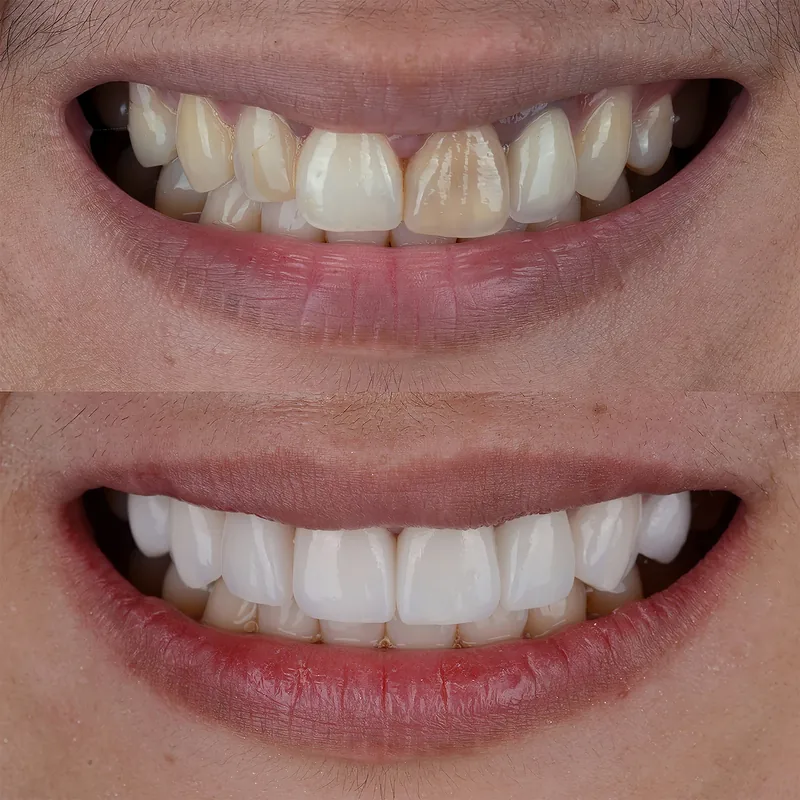
- Clinical try-in: The patient sees the proposed shape in their own mouth, while speaking and smiling, and can request adjustments before anything is prepared.
A 2018 case report by Garcia and colleagues in the Journal of Conservative Dentistry makes an important point often left out of marketing descriptions of DSD: the on-screen simulation is frequently not enough for a patient to truly grasp the planned change, which is why a physical composite mock-up in the mouth remains a necessary step, not an optional extra.

What treatments is DSD actually used for?
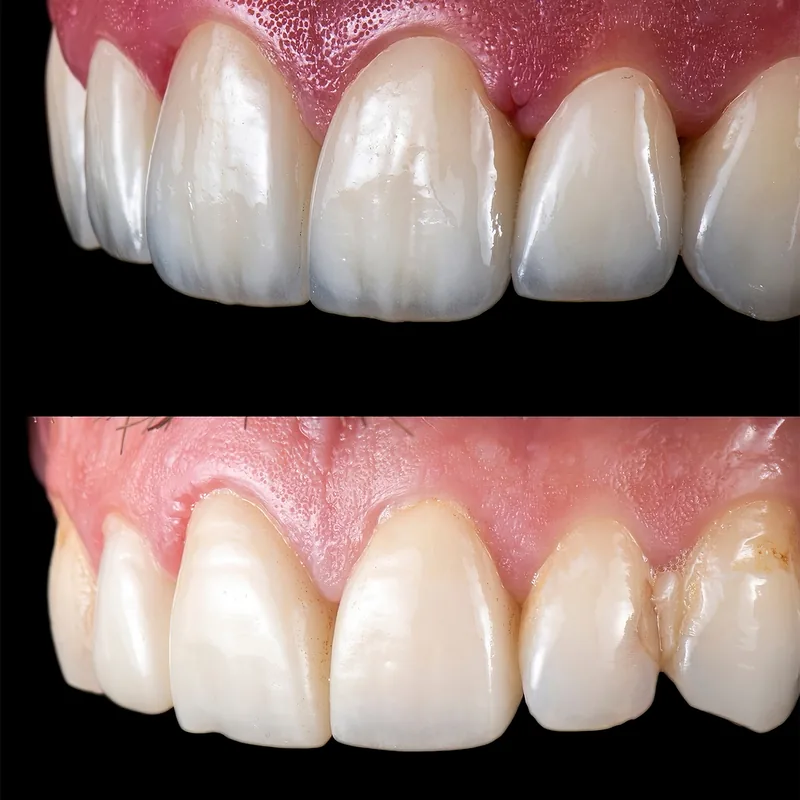
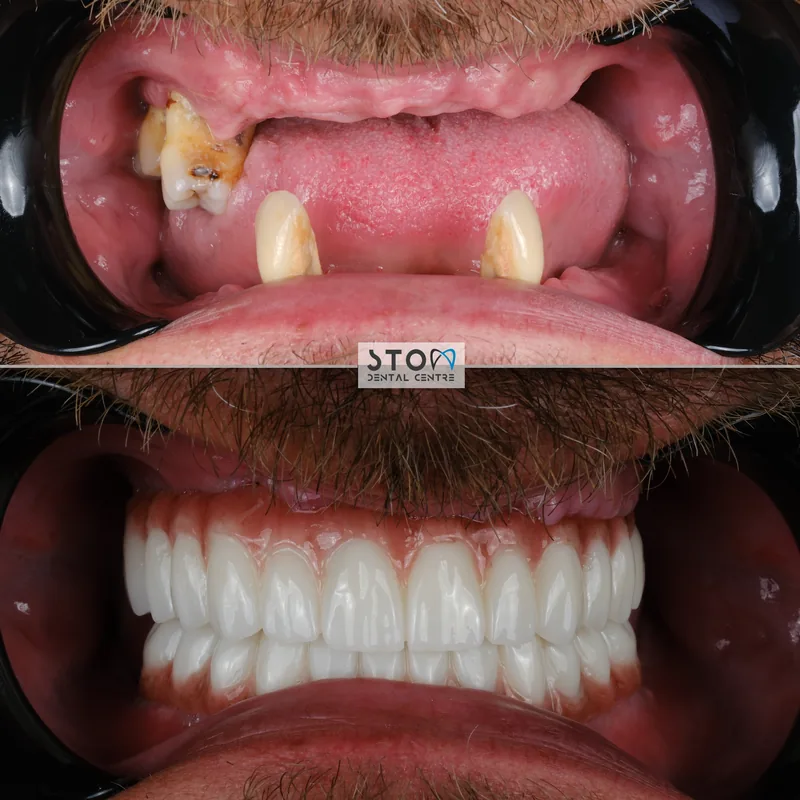
DSD is not tied to one procedure — it applies to almost any treatment affecting the esthetic zone. Documented uses include porcelain laminate veneers (Garcia et al., 2018), cases with a “gummy smile” where gum recontouring or crown-lengthening surgery is planned alongside restorative work (Arias et al., 2015; Santos et al., 2017), implant-supported full-arch rehabilitations such as All-on-4 (Cattoni et al., 2021), and interdisciplinary cases in which orthodontic treatment (for example with aligners) is planned together with periodontal, surgical or prosthetic steps (Creagh et al., 2022; Cofar et al., 2022 — both case reports). The common thread: whenever more than one specialty — prosthodontics, periodontics, orthodontics, implant surgery — needs to work toward the same visual goal, DSD gives the team a shared reference plan.

What does the research actually say about DSD’s benefits?
Randomized controlled trials show measurably higher patient satisfaction with DSD-planned treatment compared with conventional planning. In a 2024 randomized controlled trial of 150 patients published in the Journal of Pharmacy and Bioallied Sciences, Luniyal and colleagues found a mean satisfaction score (0-100 visual analog scale) of 85.4 (±6.2) in the DSD group versus 79.8 (±7.1) in the conventional group, and 92% of DSD patients achieved an “excellent” outcome rating for fit, occlusion and esthetics at three months, versus 78% in the conventional group. A separate 2021 randomized trial by Cattoni and colleagues, published in the International Journal of Environmental Research and Public Health, followed 50 patients receiving implant-supported All-on-4 rehabilitation over four years: 4-year success was 100% in the digital-workflow group versus 98% with the traditional protocol, and patients rated the digital smile preview as “very effective” 93% of the time and the mock-up try-in 98% of the time. Two independent systematic reviews, covering 10 studies (Jain et al., 2024) and 7 studies (Alwabel et al., 2025) respectively, both conclude that DSD consistently improves communication, treatment acceptance and patient satisfaction compared with conventional approaches.
What are DSD’s limits — what can it not do?
DSD is not a guarantee, and it does not replace a clinical exam, imaging, or the dentist’s own judgment. Coachman’s own 2017 paper states this directly: medical and dental history, clinical examination, study models and photographs remain the data that a proper diagnosis rests on — they simply are not sufficient on their own to plan smile harmony with the lips and face, which is why video documentation was added, and even video is only an input into a plan that is ultimately confirmed by real intraoral tissue (gum health, bone structure, the bite). Garcia and colleagues’ 2018 case report reinforces the same point from the other direction: the digital preview alone is often not persuasive enough for a patient, which is exactly why a physical mock-up trial in the mouth remains standard practice rather than an optional add-on. The 2024 and 2025 systematic reviews likewise flag that the evidence base, while consistently positive, still rests on small sample sizes, short follow-up periods and non-standardized outcome measures — reasons to treat DSD as a strong planning and communication tool, not as a promise of a specific final result.
Digital Smile Design vs. conventional planning — what’s actually different?
With conventional planning, the patient typically sees the final result only after the restorations are cemented; with DSD, the planned shape is visible both on screen and as a mock-up tried in the mouth before any tooth is touched. The core difference is when feedback happens: in a conventional workflow, photos and impressions travel between dentist and lab with limited room for patient input along the way; in a DSD workflow, dentist, patient and lab work from the same digital plan, and the patient can ask for changes to a physical model before production begins.
| Criterion | Conventional Planning | Digital Smile Design (DSD) |
|---|---|---|
| Basis of analysis | Static photos, visual estimation | Photo + video (including lip dynamics), digital measurement |
| Patient preview | Usually none, or a limited wax model | 2D digital simulation plus in-mouth mock-up trial |
| Team communication | Written prescription/impression, limited feedback loop | Shared digital plan; dentist, lab and patient reference the same design |
| Room for change | Usually only after fabrication, at extra cost | During the mock-up stage, before fabrication |
| Evidence base | Long-established standard method | RCT-supported measurable satisfaction gains (Luniyal et al., 2024; Cattoni et al., 2021) |
| Limitation | Higher risk of an unexpected final result | Does not replace clinical exam or tissue health assessment |

How is DSD used at Stom Dental Centre?
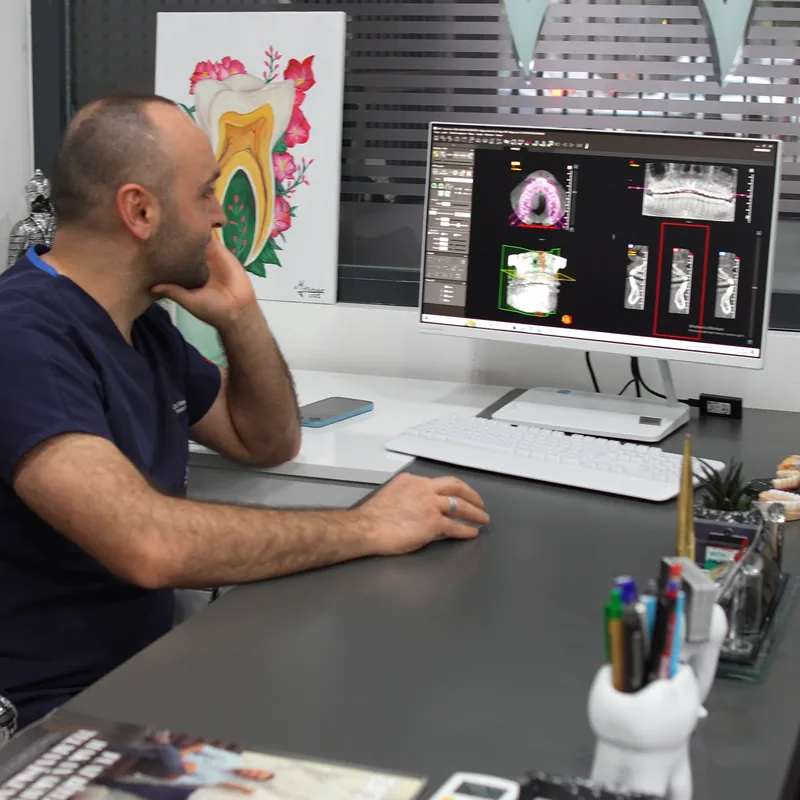
At Stom Dental Centre, esthetic cases go through a planning process that combines digital photo/video smile analysis with CBCT (3D jaw and bone imaging). The logic is straightforward: DSD analyzes the visible surface — teeth, gums, lips — while CBCT shows the underlying bone structure, root position and, in implant cases, available bone volume; together they support a plan that is realistic both esthetically and biologically. Depending on the case, the prosthetic, periodontal and (where relevant) implant surgery team work from the same digital plan, and the design is confirmed with the patient via an in-mouth mock-up before any preparation begins. This section describes a general clinical process, not a clinic-specific outcome statistic — the research figures cited above come from independent published studies on the DSD method itself.
How should I prepare for a DSD consultation as a patient?
A DSD session usually takes longer than a routine check-up because it involves standardized photos, a short video, and digital measurement. It helps to note beforehand exactly what bothers you about your smile — tooth color, gaps, gum visibility, symmetry — so the dentist’s analysis reflects your actual priorities rather than a generic template. The mock-up trial typically happens at the same visit or a follow-up one; giving direct feedback on shape, length or proportion at that stage is expected and welcome, since that feedback loop is the entire point of the mock-up.
Frequently Asked Questions
Is Digital Smile Design a treatment on its own?
No. DSD is not a treatment — it is a digital analysis and communication method used to plan existing esthetic treatments (veneers, crowns, implants, gum surgery, etc.) more predictably.
How long does a DSD analysis take?
Photo and video capture plus digital analysis is usually completed in one consultation visit; preparing the wax-up or mock-up can take additional time depending on case complexity.
Will the on-screen simulation look exactly like my final result?
Not necessarily. The simulation is a prediction, and gum healing, the chosen material, and intraoral conditions all influence the final appearance — which is why the in-mouth mock-up is a more reliable reference than the screen image.
Planning dental treatment in Antalya?
Get a free, no-obligation assessment from our clinical team — we reply within 24 hours.
Can I try the planned smile in my mouth before committing to treatment?
Yes — this step, the mock-up try-in, is a standard part of the DSD protocol, and its entire purpose is to let you see shape and length in your own mouth before anything permanent happens.
Can DSD be combined with dental implants?
Yes. Published research uses DSD to coordinate surgical and prosthetic planning in implant-supported full-arch rehabilitations such as All-on-4 (Cattoni et al., 2021).
Does DSD replace an orthodontic evaluation?
No. If the root cause of a misaligned smile is skeletal or involves tooth movement, that requires a separate orthodontic assessment; DSD is a visual planning layer that complements this evaluation, not a substitute for it.
Is DSD only for a dramatic “Hollywood smile,” or can it be used for subtle, natural-looking changes too?
Both. The method is used to visualize whatever look is targeted — natural, moderate or more pronounced — and the scope of the design is set by the patient’s preference and the clinical situation, not by the software.
Who performs the DSD analysis at Stom Dental Centre?
Esthetic and prosthetic planning is led by the clinical team under Dr. Telman Iskender; implant-involving cases are coordinated with the implant surgery team.
Sources
- Coachman C, Calamita M. “Digital Smile Design: A Tool for Treatment Planning and Communication in Esthetic Dentistry.” Quintessence of Dental Technology (QDT) 2012;35:103-111.
- Coachman C, Calamita MA, Sesma N. “Dynamic Documentation of the Smile and the 2D/3D Digital Smile Design Process.” International Journal of Periodontics & Restorative Dentistry 2017;37(2):183-193. PMID: 28196157.
- Garcia PP, da Costa RG, Calgaro M, Ritter AV, Correr GM, da Cunha LF, Gonzaga CC. “Digital smile design and mock-up technique for esthetic treatment planning with porcelain laminate veneers.” Journal of Conservative Dentistry 2018;21(4):455-458. PMID: 30122831.
- Arias DM, Trushkowsky RD, Brea LM, David SB. “Treatment of the Patient with Gummy Smile in Conjunction with Digital Smile Approach.” Dental Clinics of North America 2015;59(3):703-716. PMID: 26140976.
- Santos FR, Kamarowski SF, Lopez CAV, Storrer CLM, Neto AT, Deliberador TM. “The use of the digital smile design concept as an auxiliary tool in periodontal plastic surgery.” Dental Research Journal (Isfahan) 2017;14(2):158-161. PMID: 28584541.
- Cattoni F, Chirico L, Merlone A, Manacorda M, Vinci R, Gherlone EF. “Digital Smile Designed Computer-Aided Surgery versus Traditional Workflow in ‘All on Four’ Rehabilitations: A Randomized Clinical Trial with 4-Years Follow-Up.” International Journal of Environmental Research and Public Health 2021;18(7):3449. PMID: 33810379.
- Creagh J, Bohner L, Sesma N, Coachman C. “Digital approaches to facially guided orthodontic and periodontal rehabilitation in the anterior esthetic zone: A case report.” Journal of Esthetic and Restorative Dentistry 2022;34(1):226-234. PMID: 34989100.
- Cofar F, Barbur I, Giordani G, Giordani M, Popp I, Lascu G, Van Dooren E, Bratu T, Blatz M. “Multidisciplinary design: Creating a common perspective in complex cases.” Journal of Esthetic and Restorative Dentistry 2022;34(1):244-251. PMID: 35083848.
- Luniyal C, Shukla AK, Priyadarshi M, Ahmed F, Kumari N, Bankoti P, Makkad RS. “Assessment of Patient Satisfaction and Treatment Outcomes in Digital Smile Design vs. Conventional Smile Design: A Randomized Controlled Trial.” Journal of Pharmacy and Bioallied Sciences 2024;16(Suppl 1):S669-S671. PMID: 38595496.
- Jain A, Bhushan P, Mahato M, Solanki BB, Dutta D, Hota S, Raut A, Mohanty AK. “The Recent Use, Patient Satisfaction, and Advancement in Digital Smile Designing: A Systematic Review.” Cureus 2024;16(6):e62459. PMID: 39022468.
- Alwabel LK, Alabduljabar WM, Alawfi LK, et al. “Digital Smile Design and Patient-Centered Outcomes in Esthetic Restorative Dentistry: A Systematic Review.” Cureus 2025;17(11):e98084. PMID: 41473620.
This article is for informational purposes only and does not replace a dental examination. Decisions about DSD and related treatments should be made individually with your dentist, based on your clinical situation. The figures cited above are drawn from independent published studies and are not a guarantee of outcome at any specific clinic.