Teeth Whitening 2026: Methods, Longevity, In-Office or At-Home? A Science-Based Guide
Teeth whitening is the most requested procedure in cosmetic dentistry — and the one surrounded by the most misinformation. Social media promises “snow-white teeth in one week with charcoal”, while some clinics market a “9-shade whitening guarantee”. The reality is simpler: teeth whitening, when performed under a dentist’s supervision, is a safe, effective and scientifically well-documented procedure — but it is not permanent, it cannot be applied to every tooth, and some methods marketed as “natural” cause permanent damage to enamel. This teeth whitening guide explains the real difference between professional teeth whitening vs at home whitening, how long the results last, and why the EU set a 6% peroxide limit — based on current studies.

- In-office and at-home (tray-based) whitening reach similar results: current meta-analyses show no significant difference in whitening efficacy between the two methods — the difference lies in speed and supervision.
- The EU rule is clear: products containing 0.1–6% hydrogen peroxide may only be used under a dentist’s supervision; only ≤0.1% is permitted for over-the-counter sale (2011/84/EU).
- It is not permanent: results last between 6 months and 2–3 years depending on habits; coffee, tea and smoking noticeably shorten that period.
- Sensitivity is the most common side effect: it occurs during/after treatment in a substantial share of patients (in studies, at rates averaging up to ~70%) — it is temporary and manageable.
- Charcoal and lemon do not whiten, they abrade: the ADA literature review points to a risk of enamel abrasion with charcoal toothpastes; lemon acid (pH ~2.3) chemically dissolves enamel.
What Is Teeth Whitening and How Does It Work?
Teeth whitening (bleaching) is the chemical breakdown of colour molecules that have penetrated enamel and dentine, using peroxide-based agents (hydrogen peroxide or carbamide peroxide). The peroxide penetrates the tooth and oxidises the colour-producing organic molecules, rendering them colourless. This is fundamentally different from surface cleaning: scaling and polishing remove deposits on top of the tooth; whitening lightens the tooth’s own colour.
This distinction matters in practice: sometimes the cause of yellowing is not discolouration but a build-up of calculus and plaque — in such cases professional cleaning comes first (see our guide to dental calculus causes and removal). The decision to whiten can only be made correctly on a clean surface, once the source of the discolouration has been identified.
Teeth Whitening Methods: An Honest Comparison
There are four main approaches on the market, and they are not all of equal value:
Performed in the clinic, with high-concentration hydrogen peroxide applied under a gum-protection barrier. It is the fastest method: visible lightening is usually achieved in a single session or a few sessions. Its biggest advantage is not speed but control — the gums are isolated, and duration and concentration are managed by the dentist.
A gel of usually 10–16% carbamide peroxide is placed in custom trays made from the dentist’s impressions and used regularly for 2–4 weeks. It is slower but scientifically very effective; the severity of sensitivity is on average lower. It starts under a dentist’s supervision and is monitored.
Products sold freely in the EU may contain ≤0.1% hydrogen peroxide — the effect of this concentration on intrinsic discolouration is very limited. It may make a small difference on light surface staining; expecting noticeable lightening is not realistic.
A whitening effect has never been demonstrated scientifically; by contrast, the risk of enamel abrasion and acid erosion is well documented. We cover these in a separate section below, together with the studies.
| Method | Active agent | Speed | Efficacy | Supervision |
|---|---|---|---|---|
| In-office whitening | High-concentration hydrogen peroxide | 1–3 sessions | High — fastest visible result | Full dentist control, gum isolation |
| At-home whitening (custom trays) | 10–16% carbamide peroxide | 2–4 weeks | High — final result similar to in-office in meta-analyses | Planned and monitored by the dentist |
| Over-the-counter strips/pens | ≤0.1% hydrogen peroxide (EU) | Weeks | Limited — only a slight surface effect | Unsupervised |
| Charcoal / baking soda / lemon | Abrasive particles / citric acid | — | Whitening effect not proven | Unsupervised + risk of enamel damage |
Professional Teeth Whitening vs At Home: Which Is Better?
So which one wins? The honest answer: in terms of final whitening, both reach a similar result. An updated systematic review and meta-analysis from 2025, together with umbrella reviews, shows no significant difference in colour-lightening efficacy between in-office and at-home (custom-tray) whitening. The difference lies in three points:
- Speed: In-office whitening delivers the result on a scale of minutes to sessions, not days. At-home whitening reaches the same point in 2–4 weeks.
- Severity of sensitivity: The risk of sensitivity is similar for both methods; however, the severity of sensitivity has been found to be lower on average with the lower concentrations used at home.
- Concentration–result relationship: A finding that debunks the marketing: according to umbrella-review data, mid-level concentrations achieve whitening comparable to the highest concentrations while reducing sensitivity. The equation “strongest gel = whitest teeth” is not scientifically correct.
In clinical practice, the frequently recommended approach is a combination of the two: a fast start in the office, consolidation at home with trays. The appropriate protocol is determined by your starting shade, the type of discolouration and your sensitivity history — which is why this decision cannot be made without an examination.
The 6% Rule: The Legal Framework of Teeth Whitening
Teeth whitening products are tightly regulated in Europe under cosmetics legislation. According to EU Council Directive 2011/84/EU:
- Products containing or releasing ≤0.1% hydrogen peroxide may be sold freely (supermarket strips and whitening toothpastes fall into this class).
- Products containing 0.1–6% hydrogen peroxide may not be sold directly to consumers; they may only be used after a clinical examination by a dentist and under the dentist’s supervision. The first application must be performed by the dentist or take place under their direct supervision.
- These products must not be used on anyone under 18.
Turkey’s cosmetics legislation is likewise structured in alignment with EU regulations; the free circulation of peroxide whitening products outside dentist supervision is not provided for there either. The logic behind the limit is simple: peroxide can cause harm in an unexamined mouth — where there is an undetected cavity, exposed dentine or inflamed gums. The purpose of the rule is not to prevent whitening, but to prevent whitening without an examination. Buying a “high-concentration” gel online means disabling this safety filter.
Is Teeth Whitening Permanent?
Is teeth whitening permanent? No — no whitening method is permanent for life. Enamel is microscopically porous; eating and drinking habits and ageing cause colour molecules to re-accumulate over time. The realistic picture is this:
- Professional whitening results typically last 6 months to 2 years; in people who limit coffee/tea and do not smoke, they can extend up to 3 years.
- In smokers the relapse is much faster: fading can become noticeable within weeks to months.
- Coffee, tea, red wine and dark fruit juices are the main re-staining agents. The first 24–48 hours after treatment are the period of highest enamel permeability — avoiding coloured drinks is the standard recommendation.
- The good news: complete relapse is rare — even after 2 years, teeth mostly remain lighter than at the start. A short “top-up” every 6–12 months maintains the result.
The practical takeaway: any advert promising you “permanent whiteness” or a “9-shade whitening guarantee” is speaking the language of marketing, not science. How many shades you gain depends on your starting shade and the type of discolouration and cannot be guaranteed in advance; how long it lasts depends largely on your habits.
Is Teeth Whitening Safe? The Truth About Sensitivity
Is teeth whitening safe? Under a dentist’s supervision, applied to healthy teeth, yes — the clinical literature shows that whitening performed with the correct protocol does not cause permanent structural damage to enamel. But “harmless” and “free of side effects” are not the same thing. The most common side effect is temporary tooth sensitivity: pooled data report it during/after treatment at rates averaging up to ~70%. It is felt as cold sensitivity and short “zinging” episodes; it typically resolves on its own within a few days.
How is sensitivity managed?
- Adjusting concentration and duration: Mid-level concentrations produce less sensitivity at similar whiteness; the protocol is chosen based on your sensitivity history.
- Taking breaks: With at-home whitening, a 1–2 day pause reduces sensitivity without compromising the result.
- Desensitising agents: Potassium nitrate toothpastes, fluoride and CPP-ACP creams reduce sensitivity.
- Light/laser activation is not necessary: Meta-analyses have shown that light activation can be associated with additional sensitivity rather than additional whiteness.
The real risk of harm lies in unsupervised use: peroxide on an unexamined cavity can cause severe pain, and high-concentration gel touching unprotected gums can cause a chemical burn. The right way to phrase the question is not “is whitening harmful?” but “who is performing this whitening, and under what supervision?”
“Natural Whitening” Myths: Charcoal, Baking Soda, Lemon
Social media’s three most popular “natural” methods fail when put under scientific scrutiny:
Activated charcoal
The American Dental Association’s (ADA) literature review concluded that there is insufficient evidence that charcoal toothpastes are a safe or effective whitener; the majority of studies pointed to a risk of enamel abrasion. The abrasivity of some charcoal products is well above the safe limit for daily use. A fine irony: because yellow dentine shows through the worn enamel, the teeth of long-term charcoal users can end up looking more yellow over time.
Lemon (citric acid)
Lemon juice has a pH of about 2.3 — as acidic as vinegar. Laboratory studies have shown that contact with citric acid causes a measurable drop in enamel hardness and erodes enamel and the dentine beneath it. The sensation of “whitening” with acid is actually the chemical dissolution of enamel.
Baking soda
Baking soda is a low-abrasivity cleaner and can remove surface staining from coffee and tea — which is why it is already in many toothpastes. But that is cleaning, not whitening: it cannot lighten the tooth’s own colour. The real danger is the combination: brushing enamel softened by lemon with baking soda multiplies and accelerates the wear.
The Critical Fact: Crowns, Veneers and Fillings Do Not Whiten
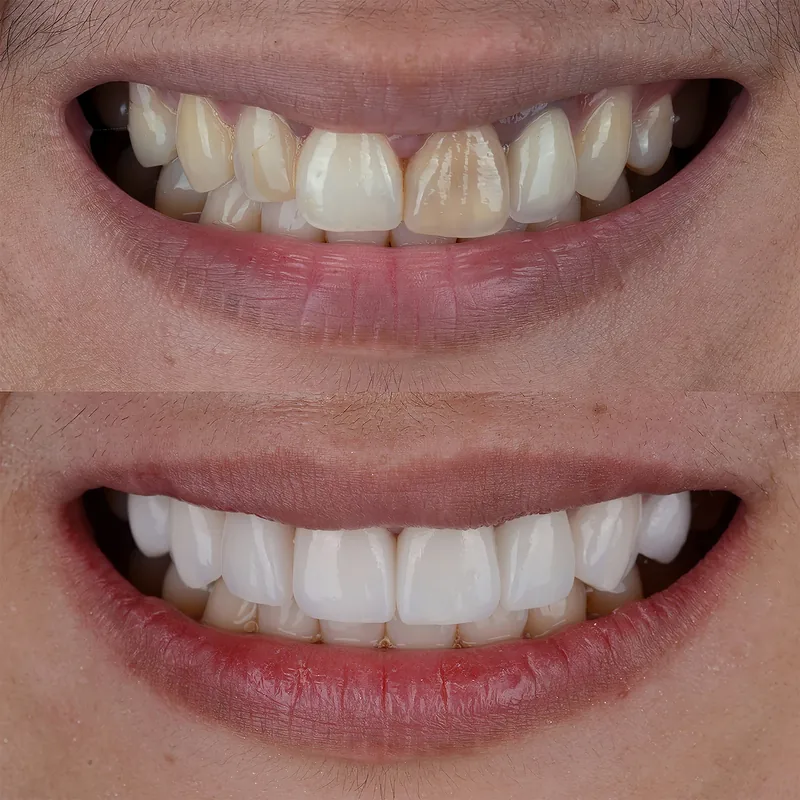
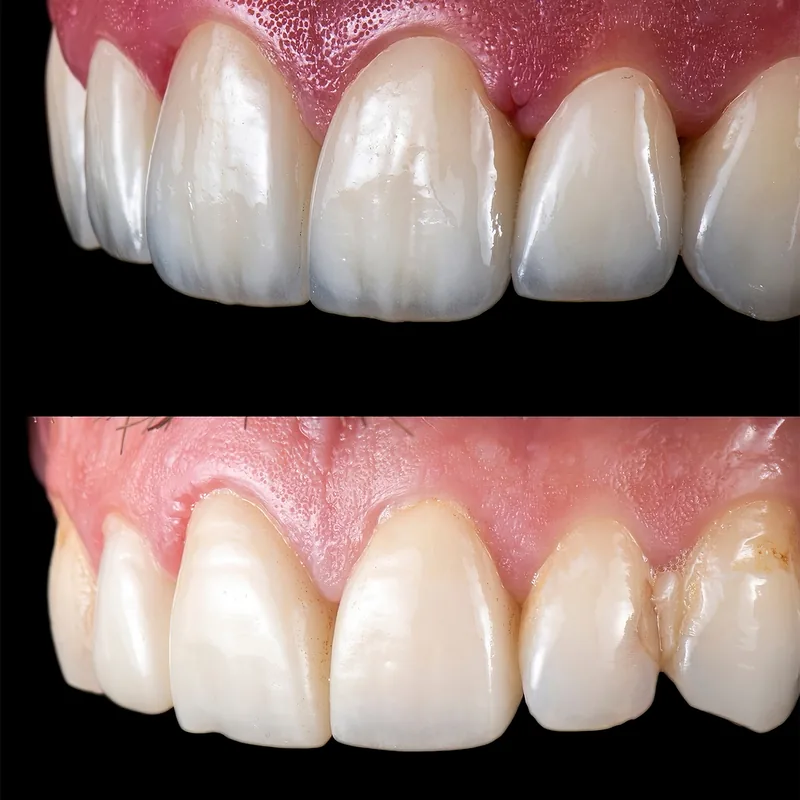
The most frequently overlooked point in whitening planning: peroxide only lightens natural tooth tissue. Porcelain crowns, laminate veneers and composite fillings do not change colour. If a patient with restorations in the front area has whitening done, the natural teeth lighten while the restorations keep their old shade — the smile can look “patchy” due to the colour mismatch.
The correct sequence is exactly the other way round:
Planning dental treatment in Antalya?
Get a free, no-obligation assessment from our clinical team — we reply within 24 hours.
- Whitening first, then the shade stabilises for 1–2 weeks (the colour rebounds slightly; this waiting period is also recommended for composite bond strength).
- Then the restorations are renewed to match the new shade — old fillings with composite bonding, crowns matched to the new shade with options such as E-max veneers/crowns.
For anyone with a crown, veneer or large filling in the visible area, whitening is not a stand-alone procedure but the first step of holistic smile planning — details in our Hollywood Smile guide.
Who Should Not Have Teeth Whitening?
- Under 18: EU regulation does not provide for peroxide whitening under 18; in young teeth the pulp chamber is large and the sensitivity risk is high.
- Pregnancy and breastfeeding: There is no evidence of harm, but safety data are also insufficient — as an elective procedure, it is postponed until after birth.
- Untreated cavities, exposed dentine, broken fillings: Peroxide reaches the pulp through these routes and can cause severe pain. Treatment first, whitening after.
- Active gum inflammation: Peroxide on inflamed tissue is painful and disrupts healing; periodontal health must be restored first.
- Uncontrolled severe sensitivity: Its cause (erosion, exposed root surface, crack) must be diagnosed first.
This list is the practical rationale behind the “0.1–6% peroxide only under dentist supervision” rule: none of these conditions is asked about when ordering gel online — they are detected in an examination.
Frequently Asked Questions
Is teeth whitening permanent?
No. Results generally last between 6 months and 2–3 years depending on habits. Coffee, tea and smoking shorten the period; whiteness can be maintained with a short top-up every 6–12 months. Complete relapse is rare — teeth mostly remain lighter than at the start.
Which is more effective: in-office or at-home whitening?
According to meta-analyses, the final whitening efficacy is similar. In-office whitening delivers faster results and full dentist control; at-home whitening with custom trays is slower, but the severity of sensitivity is on average lower. A frequently used approach is a combination of the two.
Is teeth whitening harmful — does it damage enamel?
Under a dentist’s supervision, applied to healthy teeth with the correct protocol, there is no evidence of permanent structural damage to enamel. The most common side effect is temporary sensitivity, which resolves within a few days. The real risk lies in unsupervised use: unexamined high-concentration gels and acidic/abrasive “natural” methods can cause damage.
How long does sensitivity last after whitening?
It typically appears during the procedure and in the first 24–72 hours afterwards and subsides on its own. Potassium nitrate toothpaste, fluoride or CPP-ACP application, and a 1–2 day pause during at-home use noticeably reduce sensitivity. Pain that keeps increasing over several days is not normal — see your dentist.
Does whitening teeth with charcoal or lemon work?
No. The ADA literature review found insufficient evidence that charcoal products are effective and safe, and pointed to a risk of enamel abrasion. Lemon acid (pH ~2.3) chemically dissolves enamel. Neither can lighten the tooth’s own colour; the damage they cause, however, is permanent.
Will my crowns and fillings whiten too?
No — peroxide only lightens natural tooth tissue; porcelain crowns, veneers and composite fillings do not change colour. For those with restorations in the visible area, the correct order is: whitening first, then matching the restorations to the new shade once the colour has stabilised.
Do whitening strips and whitening toothpastes work?
To a limited extent. Products sold over the counter in the EU may contain at most 0.1% hydrogen peroxide; this concentration can make a small difference on light surface staining but cannot noticeably lighten the tooth’s own colour. Most whitening toothpastes clean abrasively — that is surface cleaning, not whitening.
How many shades does teeth whitening lighten — can it be guaranteed?
How many shades you gain depends on your starting shade and the type of discolouration — it cannot be guaranteed in advance. Promises such as a “9-shade guarantee” are marketing language; a serious dentist will state a realistic range after an examination, not a guarantee.
Sources
- At-home vs In-office Bleaching: An Updated Systematic Review and Meta-analysis — Operative Dentistry (2025): no significant difference in efficacy between in-office and at-home whitening; sensitivity risk similar, severity lower with at-home whitening. pubmed.ncbi.nlm.nih.gov/40485133
- In-office tooth bleaching protocols: an umbrella review of systematic reviews and meta-analyses on whitening efficacy and tooth sensitivity — The Saudi Dental Journal (2026): mid-level concentrations deliver whitening comparable to high concentrations with less sensitivity. link.springer.com
- Comparison of in-office and at-home bleaching techniques: An umbrella review of efficacy and post-operative sensitivity — Heliyon (2024). pmc.ncbi.nlm.nih.gov/articles/PMC10873745
- Council Directive 2011/84/EU — hydrogen peroxide limits: ≤0.1% over-the-counter; 0.1–6% only under dentist supervision, not to be used under 18. Summary: GDC Tooth Whitening Position Statement
- The effects of light on bleaching and tooth sensitivity during in-office vital bleaching: a systematic review and meta-analysis — Journal of Dentistry (2012): light activation associated with additional sensitivity. pubmed.ncbi.nlm.nih.gov/22525016
- Whitening — American Dental Association, Oral Health Topics: whitening mechanism, safety, and assessment of insufficient evidence / abrasion risk for charcoal products. ada.org
- Treatment Durations and Whitening Outcomes of Different Tooth Whitening Systems — PMC (2023): duration–effect comparison across systems; data on longevity and relapse. ncbi.nlm.nih.gov/pmc/articles/PMC10302806
This article is for information purposes and does not replace an examination. The decision to whiten should be made together with your dentist after a clinical examination in which the health of your teeth and gums is assessed. Rates and findings are taken from independent scientific publications and do not constitute a guarantee of results at any specific clinic.